

OANDP-L
  • Login
No Result
View All Result
The O&P EDGE
  • PECOS
  • Magazine
    • Subscription
    • Current Issue
    • Issue Archive
    • News Archive
    • Product & Service Directory
    • Advertising Information
    • EDGE Flipbooks
  • O&P Jobs
    • Find a Job
    • Post a Job
  • EDGE Advantage
    • EA Homepage
    • EA Data
  • O&P Facilities
  • Resources
    • Product & Service Directory
    • Calendar
    • Contact
    • About Us
    • O&P Library
    • The Guide
    • Custom Publications
    • Advertising Information
    • EDGE Direct
    • Amplitude Media Group
  • PECOS
  • Magazine
    • Subscription
    • Current Issue
    • Issue Archive
    • News Archive
    • Product & Service Directory
    • Advertising Information
    • EDGE Flipbooks
  • O&P Jobs
    • Find a Job
    • Post a Job
  • EDGE Advantage
    • EA Homepage
    • EA Data
  • O&P Facilities
  • Resources
    • Product & Service Directory
    • Calendar
    • Contact
    • About Us
    • O&P Library
    • The Guide
    • Custom Publications
    • Advertising Information
    • EDGE Direct
    • Amplitude Media Group
No Result
View All Result
The O&P EDGE Magazine
No Result
View All Result
Home News

Modified Robotic Prosthesis May Address Hip, Back Problems

by The O&P EDGE
November 20, 2025
in News
0
SHARES
662
VIEWS
Share on FacebookShare on Twitter

Researchers have developed a new algorithm that combines two processes for personalizing robotic prosthetic devices to optimize the movement of the prosthetic limb and help a human user’s body engage in a more natural walking pattern. The new approach could be used to help restore and maintain various aspects of user movement, with the goal of addressing health challenges associated with amputation.
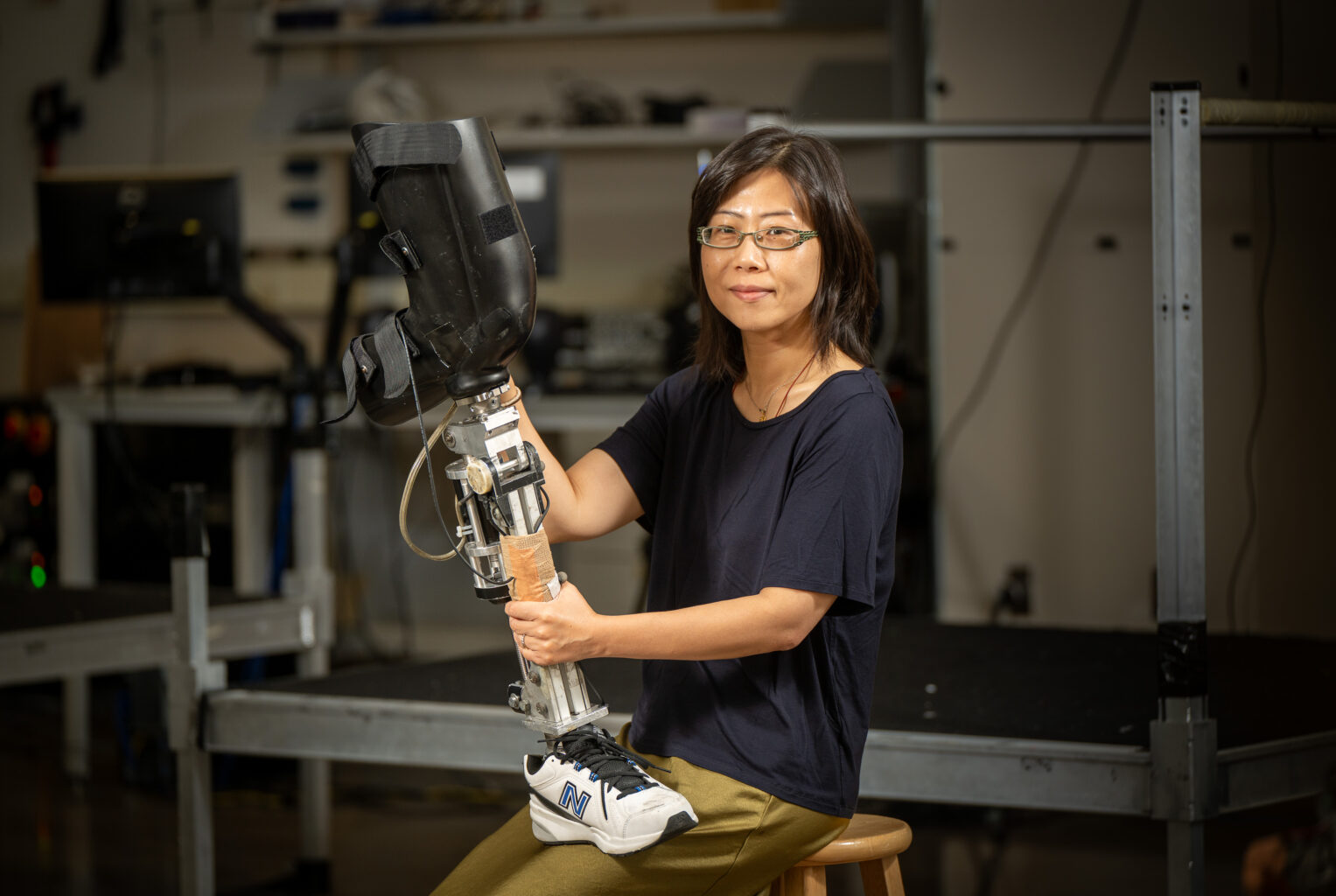
Huang. Photograph by Marc Hall courtesy of North Carolina State University.

“Algorithms designed to improve the behavior of robotic prosthetics are not new, but this is the first algorithm that also holistically improves the physical behavior of the person interacting with those prosthetics,” said Varun Nalam, PhD, an assistant research professor in the Lampe Joint Department of Biomedical Engineering at North Carolina State University and the University of North Carolina at Chapel Hill, and co-lead and co-corresponding author of a paper on the work.

“When people have an amputation above the knee, it affects the way they move other parts of their body,”  Nalam said. “That can lead to lower back pain, hip problems, and so on. Robotic prostheses to this point have focused on replacing the movement of the missing joint. So, for example, the software that governs the behavior of robotic prosthetic knees has focused solely on optimizing the movement of the prosthetic knee joint.

“Our goal with this work was to develop a new algorithm that allows us to do two things,” he said. “We still want to ensure that the prosthetic knee joint is functioning properly—but we also want to ensure that the user’s body is also moving in the same way that it would have before the amputation. This not only gives the user the full range of leg motion, but will also help to avoid lower back pain, hip problems, et cetera.”

The new research builds on previous work in which the researchers developed an intelligent system for tuning powered prosthetic knees. That system allowed patients to walk comfortably with the prosthetic device in minutes, rather than the hours necessary if the device were tuned by a trained clinical practitioner. The system was the first to rely solely on reinforcement learning to tune a robotic prosthesis.

“That work achieved optimal prosthesis control via a reinforcement learning algorithm,” said Helen Huang, PhD, senior author of the paper and the Jackson Family Distinguished Professor of Biomedical Engineering in the Lampe Joint Department. “However, it focused solely on the behavior of the prosthetics. In this new work, we’ve built on that earlier system with a new algorithm that uses inverse reinforcement learning to account for the movement of both the prosthetic and the person using it.”

The robotic prosthetic knee incorporates sensors to track its movement. In proof-of-concept testing, the researchers also focused on the user’s hip movement, which was monitored via sensors connected to the wearer.

“The new algorithm essentially accounts for the movement of both joints—the prosthetic knee and the user’s hip—and adjusts the behavior of the prosthetic knee to help the user exhibit their natural hip movement,” Nalam said.

“While we focused on hip movement for this study, the algorithm could also be used to help users with trunk movement, walking symmetrically, or other aspects of human performance,” Huang said.

To test the new algorithm, the researchers recruited two participants with unilateral transfemoral amputations  and three participants without amputations who performed a series of tasks using a robotic prosthetic knee under two conditions. In the first condition, the knee was operated using software that incorporated only the earlier system for knee control. In the second condition, the software incorporated the new combination of algorithms.

“The main finding here was that incorporating the new algorithm improved hip range of motion for all five subjects, which demonstrates that it can make a difference for hip health,” said Nalam. “We also found that the new algorithm changed the gait of our study subjects in ways which indicate that movement felt more natural for users. For example, they took longer steps when walking.”

“From a practical standpoint, next steps include working with clinicians to see how it affects user well-being over time,” said Huang. “We’re also interested in working with companies that make robotic prosthetics to explore questions associated with incorporating this approach into their software.”

“From a research standpoint, we are interested in determining how this approach can be used to help address a range of human locomotive behaviors,” Nalam said.

Editor’s note: This story was adapted from materials provided by North Carolina State University.

The study, “Addressing human-robot symbiosis via bilevel optimization of robotic knee prosthesis control,” was published in IEEE Transactions on Robotics.

 

Related posts:

  1. 3D Printing: Making It Work
  2. Endolite Enhances Quality of Life
  3. Review Mulls OI Post-operative Rehabilitation Protocols
  4. Just in Time for the Annual Meeting: Academy Annual Meeting Sessions Sneak Peek
Previous Post

BOC Names 2025 Jim Newberry Award Winner

Next Post

Running Improves Symmetry Scores for Transtibial Amputees

Next Post

Running Improves Symmetry Scores for Transtibial Amputees

 SUBSCRIBE FOR FREE


Get unlimited access!

Join EDGE ADVANTAGE and unlock The O&P EDGE's vast library of archived content.
SUBSCRIBE TODAY

O&P JOBS

Central

Texas Board–Eligible Prosthetist or Licensed Prosthetic Assistant  

Central

Certified Prosthetist/Orthotist

Pacific

Certified Prosthetist

Linkedin X-twitter Facebook
The O&P EDGE Magazine
 
Required 'Candidate' login to applying this job. Click here to logout And try again
 

Login to your account

  • Forgot Password?

Reset Password

  • Already have an account? Login

Enter the username or e-mail you used in your profile. A password reset link will be sent to you by email.

Close
No Result
View All Result
  • PECOS
  • MAGAZINE
    • SUBSCRIBE
    • CURRENT ISSUE
    • ISSUE ARCHIVE
    • NEWS ARCHIVE
    • PRODUCTS & SERVICES DIRECTORY
    • ADVERTISING INFORMATION
  • O&P JOBS
    • FIND A JOB
    • POST A JOB
  • EDGE ADVANTAGE
    • EA Homepage
    • EA Data
  • FACILITIES
  • RESOURCES
    • PRODUCTS & SERVICES DIRECTORY
    • CALENDAR
    • CONTACT
    • ABOUT US
    • O&P LIBRARY
    • THE GUIDE
    • CUSTOM PUBLICATIONS
    • ADVERTISING INFORMATION
    • EDGE DIRECT
    • AMPLITUDE
  • OANDP-L
  • LOGIN

© 2025 The O&P EDGE

Are you sure want to unlock this post?
Unlock left : 0
Are you sure want to cancel subscription?
 

Account Activation

Before you can login, you must activate your account with the code sent to your email address. If you did not receive this email, please check your junk/spam folder. Click here to resend the activation email. If you entered an incorrect email address, you will need to re-register with the correct email address.


© 2024 The O&P EDGE

  • About
  • Advertise
  • Contact
  • EDGE Advantage
  • OANDP-L
  • Subscribe

CONTACT US

866-613-0257

info@opedge.com

201 E. 4th St.
Loveland, CO 80537

The most important industry news and events delivered directly to your inbox every week.

  • About
  • Advertise
  • Contact
  • EDGE Advantage
  • OANDP-L
  • Subscribe

© 2025 The O&P EDGE

Welcome Back!

Login to your account below

Forgotten Password?

Retrieve your password

Please enter your username or email address to reset your password.

Log In
The O&P EDGE Magazine
 
Required 'Candidate' login to applying this job. Click here to logout And try again
 

Login to your account

  • Forgot Password?

Reset Password

  • Already have an account? Login

Enter the username or e-mail you used in your profile. A password reset link will be sent to you by email.

Close
No Result
View All Result
  • PECOS
  • MAGAZINE
    • SUBSCRIBE
    • CURRENT ISSUE
    • ISSUE ARCHIVE
    • NEWS ARCHIVE
    • PRODUCTS & SERVICES DIRECTORY
    • ADVERTISING INFORMATION
  • O&P JOBS
    • FIND A JOB
    • POST A JOB
  • EDGE ADVANTAGE
    • EA Homepage
    • EA Data
  • FACILITIES
  • RESOURCES
    • PRODUCTS & SERVICES DIRECTORY
    • CALENDAR
    • CONTACT
    • ABOUT US
    • O&P LIBRARY
    • THE GUIDE
    • CUSTOM PUBLICATIONS
    • ADVERTISING INFORMATION
    • EDGE DIRECT
    • AMPLITUDE
  • OANDP-L
  • LOGIN

© 2025 The O&P EDGE

Are you sure want to unlock this post?
Unlock left : 0
Are you sure want to cancel subscription?
 

Account Activation

Before you can login, you must activate your account with the code sent to your email address. If you did not receive this email, please check your junk/spam folder. Click here to resend the activation email. If you entered an incorrect email address, you will need to re-register with the correct email address.