

OANDP-L
  • Login
No Result
View All Result
The O&P EDGE
  • PECOS
  • Magazine
    • Subscription
    • Current Issue
    • Issue Archive
    • News Archive
    • Product & Service Directory
    • Advertising Information
    • EDGE Flipbooks
  • O&P Jobs
    • Find a Job
    • Post a Job
  • EDGE Advantage
    • EA Homepage
    • EA Data
  • O&P Facilities
  • Resources
    • Product & Service Directory
    • Calendar
    • Contact
    • About Us
    • O&P Library
    • The Guide
    • Custom Publications
    • Advertising Information
    • EDGE Direct
    • Amplitude Media Group
  • PECOS
  • Magazine
    • Subscription
    • Current Issue
    • Issue Archive
    • News Archive
    • Product & Service Directory
    • Advertising Information
    • EDGE Flipbooks
  • O&P Jobs
    • Find a Job
    • Post a Job
  • EDGE Advantage
    • EA Homepage
    • EA Data
  • O&P Facilities
  • Resources
    • Product & Service Directory
    • Calendar
    • Contact
    • About Us
    • O&P Library
    • The Guide
    • Custom Publications
    • Advertising Information
    • EDGE Direct
    • Amplitude Media Group
No Result
View All Result
The O&P EDGE Magazine
No Result
View All Result
Home News

Nerve Stimulation Results: Object Size Identification, Reduced Phantom Limb Pain

by The O&P EDGE
June 9, 2023
in News
0
SHARES
24
VIEWS
Share on FacebookShare on Twitter
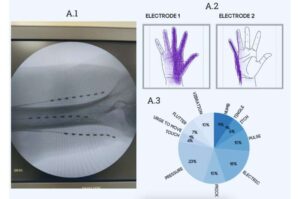
A.1- Computer tomography scans depicting electrode configuration and placement. In S01, three electrodes were implanted: in the median, ulnar and radial nerves. A.2 – The cumulative area of sensations that the subject perceived in the phantom wrist during PNS by S01; 48 pairs of frequency and pulse width values, respectively, contributed to the map. A.3 – The proportion of words that S01 used to describe the sensation he experienced. Photograph courtesy of Brain Stimulation.

Researchers in Russia reported the results of their latest experiments in sensitization of prosthetic devices and phantom pain suppression in people with bilateral hand amputations. By sensing and interpreting electrical impulses delivered to the median nerve in the upper arm, two patients were able to discriminate between larger and smaller objects using their prostheses, without looking. They also reported reduced or no phantom pain.

“When a spinal cord stimulator is used to relieve phantom pain, this has the side effect of creating a tingling sensation known as paresthesia that is poorly localized and might span the entire phantom arm. The pain itself, on the contrary, might be felt in just two phantom fingers, for example. Our experiments are pioneering the approach that could one day see phantom pain eliminated in a more focused way by stimulating peripheral nerves as opposed to the spinal cord (or the brain),” said Gurgen Soghoyan, PhD, of Skoltech Neuro, and first author of the study. Researchers from Skoltech, the Far Eastern Federal University, and prosthetic hand manufacturer Motorica participated.

Compared with spinal cord stimulators, electrodes implanted into a peripheral nerve are also less susceptible to unwanted migration, Soghoyan said. Over time, this migration causes the stimulation to affect parts of the body other than those the device was originally aimed at.

Peripheral stimulation could simultaneously serve two purposes: Besides suppressing phantom pain, it can provide sensory feedback for the prosthetic hand user to “feel” the objects they are interacting with. This could ultimately be the solution to one of the main problems of prosthetics, as perceived by the patients themselves.

“Unexpectedly, in our experiment both patients scored equally well on the task regardless of whether implanted or surface electrodes were used,” Soghoyan said. “Invasive stimulation is more stable and reliable: It creates sensations in the right areas of the phantom limb and is considered better suited for restoring sensory feedback. Well, apparently, for some patients both approaches could work equally well.”

However, a patient poll conducted by the team indicated higher embodiment scores for invasive stimulation.

In another experiment, a participant succeeded in telling the difference between a larger cylinder-shaped object from a smaller one—and from an empty hand—by holding them in 78 percent of the attempts. He received stimulation from an electrode implanted into the median nerve in his upper arm. Stimulation intensity depended on the extent to which the fingers of the prosthetic hand have been closed. The type of stimulation was chosen so that the patient perceived it as the clenching of a phantom fist.

The researchers could achieve this match between the observed hand motion and sensation because they had previously worked with the patient and documented his subjective perception of various kinds of stimulation in a so-called sensory mapping procedure. Before carrying out the test, the subject had a chance to practice by handling the cylinders with his eyes open.

As for the phantom pain suppression experiment, one of the patients said the pain disappeared completely, and the other reported a 40-70 percent decrease in pain, varying from day to day over the course of a little more than a week. Invasive stimulation was used.

“The interesting and unexpected thing here is that while the electrodes were implanted into the upper arm only on the right side of the body, one of the patients reported that the pain was no longer felt in both phantom arms. This serves to show yet again: The phantom pain mechanism involves the central nervous system,” Soghoyan said.

“The brain of an amputee is known to undergo certain readjustments that encompass the regions responsible for movement and the sense of touch—the motor and the somatosensory cortices. There are, however, only guesses so far as to how this relates to the phantom pain phenomenon.”

Editor’s note: This story was adapted from materials provided by Skolkovo Institute of Science and Technology.

The open-access study, “Peripheral nerve stimulation enables somatosensory feedback while suppressing phantom limb pain in transradial amputees,” was published in Brain Stimulation.


Related posts:

  1. Non-pharmacologic Approaches to Residual Limb and Phantom Limb Pain
  2. Losses Beyond the Limb
  3. Phantom Pain Is No Phantom
  4. Examining the Uses of Virtual Reality in Prosthetic Rehabilitation
Previous Post

OPIE Software Names Chief Technology Officer

Next Post

Do Your Processes Produce Outcomes That Advance Your Mission?

Next Post
A businessman with a laptop flies on a paper space rocket in a puff of smoke.

Do Your Processes Produce Outcomes That Advance Your Mission?

 SUBSCRIBE FOR FREE


Get unlimited access!

Join EDGE ADVANTAGE and unlock The O&P EDGE's vast library of archived content.
SUBSCRIBE TODAY

O&P JOBS

Eastern

Certified Prosthetist Orthotist (CPO)

Pacific

Certified Prosthetist Orthotist (CPO) or Certified Orthotist (CO)

Mountain

Orthotic and Prosthetic Technician

Linkedin X-twitter Facebook
The O&P EDGE Magazine
 
Required 'Candidate' login to applying this job. Click here to logout And try again
 

Login to your account

  • Forgot Password?

Reset Password

  • Already have an account? Login

Enter the username or e-mail you used in your profile. A password reset link will be sent to you by email.

Close
No Result
View All Result
  • PECOS
  • MAGAZINE
    • SUBSCRIBE
    • CURRENT ISSUE
    • ISSUE ARCHIVE
    • NEWS ARCHIVE
    • PRODUCTS & SERVICES DIRECTORY
    • ADVERTISING INFORMATION
  • O&P JOBS
    • FIND A JOB
    • POST A JOB
  • EDGE ADVANTAGE
    • EA Homepage
    • EA Data
  • FACILITIES
  • RESOURCES
    • PRODUCTS & SERVICES DIRECTORY
    • CALENDAR
    • CONTACT
    • ABOUT US
    • O&P LIBRARY
    • THE GUIDE
    • CUSTOM PUBLICATIONS
    • ADVERTISING INFORMATION
    • EDGE DIRECT
    • AMPLITUDE
  • OANDP-L
  • LOGIN

© 2025 The O&P EDGE

Are you sure want to unlock this post?
Unlock left : 0
Are you sure want to cancel subscription?
 

Account Activation

Before you can login, you must activate your account with the code sent to your email address. If you did not receive this email, please check your junk/spam folder. Click here to resend the activation email. If you entered an incorrect email address, you will need to re-register with the correct email address.


© 2024 The O&P EDGE

  • About
  • Advertise
  • Contact
  • EDGE Advantage
  • OANDP-L
  • Subscribe

CONTACT US

866-613-0257

info@opedge.com

201 E. 4th St.
Loveland, CO 80537

The most important industry news and events delivered directly to your inbox every week.

  • About
  • Advertise
  • Contact
  • EDGE Advantage
  • OANDP-L
  • Subscribe

© 2025 The O&P EDGE

Welcome Back!

Login to your account below

Forgotten Password?

Retrieve your password

Please enter your username or email address to reset your password.

Log In
The O&P EDGE Magazine
 
Required 'Candidate' login to applying this job. Click here to logout And try again
 

Login to your account

  • Forgot Password?

Reset Password

  • Already have an account? Login

Enter the username or e-mail you used in your profile. A password reset link will be sent to you by email.

Close
No Result
View All Result
  • PECOS
  • MAGAZINE
    • SUBSCRIBE
    • CURRENT ISSUE
    • ISSUE ARCHIVE
    • NEWS ARCHIVE
    • PRODUCTS & SERVICES DIRECTORY
    • ADVERTISING INFORMATION
  • O&P JOBS
    • FIND A JOB
    • POST A JOB
  • EDGE ADVANTAGE
    • EA Homepage
    • EA Data
  • FACILITIES
  • RESOURCES
    • PRODUCTS & SERVICES DIRECTORY
    • CALENDAR
    • CONTACT
    • ABOUT US
    • O&P LIBRARY
    • THE GUIDE
    • CUSTOM PUBLICATIONS
    • ADVERTISING INFORMATION
    • EDGE DIRECT
    • AMPLITUDE
  • OANDP-L
  • LOGIN

© 2025 The O&P EDGE

Are you sure want to unlock this post?
Unlock left : 0
Are you sure want to cancel subscription?
 

Account Activation

Before you can login, you must activate your account with the code sent to your email address. If you did not receive this email, please check your junk/spam folder. Click here to resend the activation email. If you entered an incorrect email address, you will need to re-register with the correct email address.