

Muscles are remarkably effective systems for generating controlled force, and engineers developing hardware for robots or prosthetic devices have struggled to create artificial methods that can approach their unique combination of strength, rapid response, scalability, and control. But now, researchers at the MIT Media Lab and Politecnico di Bari in Italy have developed artificial muscle fibers that come closer to matching many of these qualities.
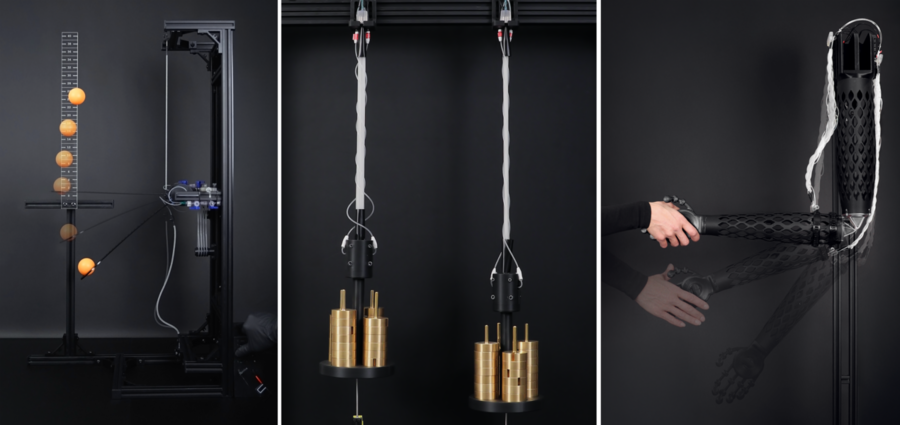
Photographs by Gabriele Pupillo and Ozgun Kilic Afsar courtesy of MIT.
Like the fibers that bundle together to form biological muscles, the new fibers can be arranged in different configurations to meet the demands of a given task. Unlike conventional robotic actuation systems, they are compliant enough to interface comfortably with the human body and operate silently without motors, external pumps, or other bulky supporting hardware.
The new electrofluidic fiber muscles—electrically driven actuators built in fiber format—bring together two technologies. One is a fluidically driven artificial muscle known as a thin McKibben actuator, and the other is a miniaturized solid-state pump based on electrohydrodynamics (EHD), which can generate pressure inside a sealed fluid compartment without moving parts or an external fluid supply.
Until now, most fluid-driven soft actuators have relied on external “heavy, bulky, oftentimes noisy hydraulic infrastructure, which makes them difficult to integrate into systems where mobility or compact, lightweight design is important,” said Ozgun Kilic Afsar, a doctoral candidate in the MIT Media Lab who is leading the work. This has created a fundamental bottleneck in the practical use of fluidic actuators in real-world applications.
The key to breaking through that bottleneck was the use of integrated pumps based on electrohydrodynamic principles.
“This is very much reminiscent of how biological muscles are configured and organized,” Afsar said. “We didn’t choose this configuration simply for the sake of biomimicry, but because we needed a way to store the fluid within the muscle design.”
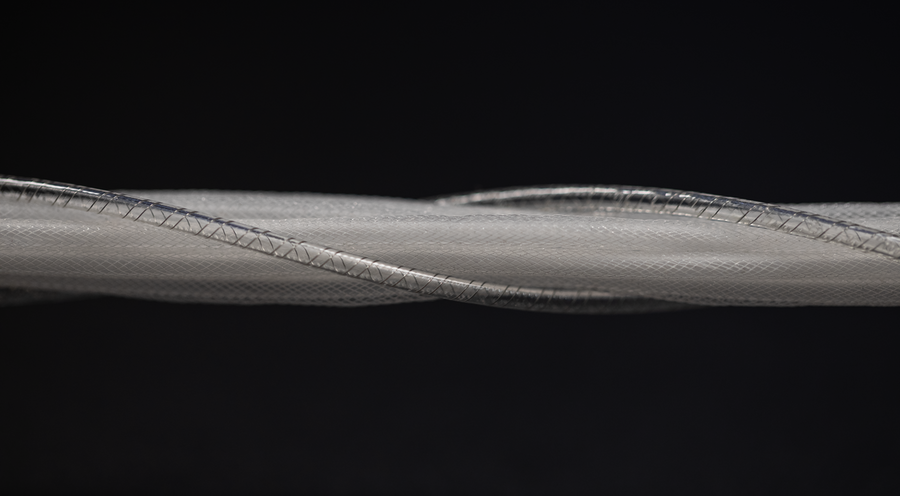
Another key finding was that the muscle fibers needed to be pre-pressurized, rather than simply filled. “There is a minimum internal system pressure that the system can tolerate, below which the pump can degrade or temporarily stop working,” Afsar said. This happens because of cavitation, in which vapor bubbles form when the pressure at the pump inlet drops below the vapor pressure of the liquid, eventually leading to dielectric breakdown.
“Most of today’s robotic limbs and hands are built around electric servo motors, whose configuration differs fundamentally from that of natural muscles,” said Vito Cacucciolo, PhD, a professor at the Politecnico di Bari. Servo motors generate rotational motion on a shaft that must be converted into linear movement, whereas muscle fibers naturally contract and extend linearly, as do these electrofluidic fibers.
This work “presents a major advancement in fiber-format soft actuation,” which “addresses several long-standing hurdles in the field, particularly regarding portability and power density,” said Herbert Shea, PhD, a professor in the Soft Transducers Laboratory at Ecole Polytechnique Federale de Lausanne in Switzerland, who was not associated with this research. “The lack of moving parts in the pump makes these muscles silent, a major advantage for prosthetic devices and assistive clothing,” he says.
Editor’s note: This story was adapted from materials provided by MIT News.
The paper, “Electrofluidic fiber muscles,” was published in Science Robotics.
To watch videos about the work, visit MIT News.