

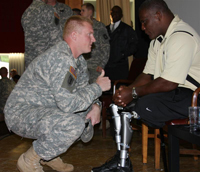
Lt. Col. Greg Gadson, shares his experiences during the rehabilitation process with a soldier in Schweinfurt, Germany. Photograph courtesy of the U.S. Army.
As unprecedented numbers of U.S. soldiers return from the wars in Iraq and Afghanistan missing arms, legs, hands, and feet, many come home to lives of greatly reduced mobility and fulfillment because poorly fitted prostheses cause infections or are too painful to wear.
Scientists from the University of Utah (U of U), Salt Lake City, Department of Orthopaedics, and Worcester Polytechnic Institute (WPI), Massachusetts, believe soldiers who have made such sacrifices deserve better. To help make that happen, researchers at the two institutions plan to use a $3 million Department of Defense (DoD) appropriation to design an “intelligent” prosthetic implant that will make artificial limbs comfortable to wear and infection-free by attaching internally to the skeleton and employing a skin seal to prevent bacteria from entering the attachment site, according to a U of U press release.
The appropriation, secured with the help of Senator Bob Bennett (R-Utah), will help both the U of U and WPI continue their respective research in a new, collaborative framework, according to Charles L. Saltzman, MD, Utah co-principal investigator on the project and professor and chair of orthopaedics at the U of U School of Medicine. The researchers plan to have an implant design ready for clinical trials within five years.
“This funding is going to allow us to support high-payoff research that will deliver significantly improved quality of life for the young men and women who have made extreme sacrifices in Iraq, Afghanistan, and elsewhere,” Saltzman was quoted as saying. “We believe it is our responsibility as a society to ensure that the utmost is done to heal them.”
Roy D. Bloebaum, PhD, director of the Bone and Joint Research Laboratory at the George E. Wahlen Department of Veterans Affairs (VA) Medical Center; research professor and Albert and Margaret Hofmann Chair in Orthopaedic Research at the U of U; and J. Peter Beck, MD, adjunct professor of orthopedics at the U of U, are also Utah co-investigators on the project. W. Grant McGimpsey, PhD, professor and director of the WPI Bioengineering Institute, and Christopher Lambert, PhD, research associate professor of bioengineering, are the co-principal investigators at WPI.
“There are many significant challenges we must overcome to bring this technology out of the lab and into the clinic,” McGimpsey said. “The collaboration between our two institutions has all of the elements necessary to achieve this goal, from basic science and engineering to clinical expertise. I am very pleased we are moving ahead on this research and that we have such a productive partnership.”
The need for a new prosthetic implant arises in large part from the increased survival of soldiers in battle. The body armor that protects a soldier’s torso from bomb and missile blasts has, along with advanced battlefield medicine, decreased mortality from injuries. But body armor does not protect arms and legs, leaving soldiers exposed to severe limb injuries that often require amputation.
These types of amputations often leave a short residual limb where the arm or leg was taken off, making it difficult, if not impossible, to fit a conventional prosthesis that is comfortable and functional. In these cases, the artificial limb also often causes skin to break down and become infected at the attachment site.
The pain and infection related to a poorly fitted prosthesis can force the wearer to discard an artificial limb altogether. It’s estimated, for example, that over 70 percent of patients with artificial arms will discard their prostheses because of pain, infection, or both, according to Bloebaum.
U of U and WPI investigators are addressing these problems in two ways.
First, they’re designing a titanium alloy implant that will attach inside the bone above where an arm or leg has been amputated. The implant will serve as a base for attaching an artificial arm, leg, hand, or foot to the residual limb, taking the weight off of the residual limb and placing it on the implant and the bone. This will allow prostheses to fit better and eliminate pain.
Second, to prevent infection, researchers headed by Bloebaum are working on a way to make skin heal around the implant in a way that stops infections. “Without an impermeable seal, bacteria can go right down the implant post,” Bloebaum said. “Our goal is to learn how to make skin heal in a way that creates a permanent seal to stop bacteria from getting into the implant site and creating infections.”
Editor’s note: This story has been adapted from materials provided by the University of Utah.