
OANDP-L
  • Login
No Result
View All Result
The O&P EDGE Magazine
  • PECOS
  • Magazine
    • Subscription
    • Current Issue
    • Issue Archive
    • News Archive
    • Product & Service Directory
    • Advertising Information
  • O&P Jobs
    • Find a Job
    • Post a Job
  • EDGE Advantage
    • EA Homepage
    • EA Data
  • O&P Facilities
  • Resources
    • Product & Service Directory
    • Calendar
    • Contact
    • About Us
    • O&P Library
    • Lower Limb Directory
    • The Guide
    • Custom Publications
    • Advertising Information
    • EDGE Direct
    • Amplitude Media Group
No Result
View All Result
The O&P EDGE Magazine
No Result
View All Result
Home News

Robotic Neuromuscular Prosthetic Leg Prevents Stumbles

by The O&P EDGE
January 3, 2022
in News
0
SHARES
20
VIEWS
Share on Facebook
Share on Twitter

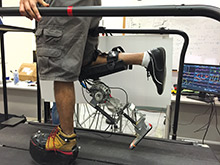
A volunteer tests gait patterns using the neuromuscular prosthetic leg. Photograph courtesy of CMU.

A robotic leg prosthesis being developed at Carnegie Mellon University (CMU) uses techniques based on the control mechanisms of the human leg to help prosthesis users avoid stumbles and reduce the risk of a fall. The control strategy, devised after the research team studied human reflexes and other neuromuscular control systems, has shown promise in simulation and in laboratory testing, where it has produced stable gaits over uneven terrain and better recovery from trips and shoves.

The researchers found that the neuromuscular control method can reproduce normal walking patterns and that it effectively responds to disturbances as the leg begins to swing forward and late in the swing. More work is necessary, however, because the control scheme doesn’t yet respond effectively to disturbances at mid-swing, according to the team.

The researchers studied the role of the leg extensor muscles because the force feedback from these muscles automatically responds to ground disturbances, quickly slowing or extending leg movement, as necessary. The team-Hartmut Geyer, PhD, assistant professor of robotics; Steve Collins, PhD, associate professor of mechanical engineering and robotics; and Santiago Munoz, CPO, instructor in the department of rehabilitation science and technology at the University of Pittsburg-evaluated the neuromuscular model by using computer simulations and a cable-driven device about half the size of a human leg, called the Robotic Neuromuscular Leg 2. Over the next three years, as part of a $900,000 National Robotics Initiative study funded through the National Science Foundation, the technology will be further developed and tested using volunteers with transfemoral amputations.

“Today’s prosthetics try to mimic natural leg motion, yet they can’t respond like a healthy human leg would to trips, stumbles, and pushes,” said Geyer. “Our work is motivated by the idea that if we understand how humans control their limbs, we can use those principles to control robotic limbs.”

Geyer’s latest findings applying the neuromuscular control scheme to prosthetic legs and, in simulation, to full-size walking robots, were presented at the IEEE International Conference on Intelligent Robots and Systems in Hamburg, Germany. An upcoming paper in IEEE Transactions in Biomedical Engineering focuses specifically on how this control scheme can improve balance recovery.

Editor’s note: This story was adapted from materials provided by CMU.
Related posts:

  1. I, ROBOT
  2. Orthotic Technology Enters a New Age
  3. Josh Caputo and HuMoTech: Creating a Way to Test-drive Prosthetic Feet
  4. Climbing to Westworld: Realism in Prosthetic Design
Previous Post

Equation Predicts Diabetes-Related Amputation, Vision Loss Risk

Next Post

2014 Paralympic Sled Hockey Team Named IPC Best Team

Next Post

2014 Paralympic Sled Hockey Team Named IPC Best Team

Read the Current Issue

SUBSCRIBE FOR FREE


O&P JOBS

Eastern

Certified Prosthetist/Orthotist (CPO)

Eastern

Now Hiring: Certified Prosthetist Orthotist (CPO)

Eastern

ABC Certified Orthotic Fitter / Orthotic Assistant

Linkedin X-twitter Facebook

Get unlimited access!

Join EDGE ADVANTAGE and unlock The O&P EDGE's vast library of archived content.
SUBSCRIBE TODAY


© 2026 The O&P EDGE

  • About
  • Advertise
  • Contact
  • EDGE Advantage
  • OANDP-L
  • Subscribe

CONTACT US

866-613-0257

info@opedge.com

201 E. 4th St.
Loveland, CO 80537

EDGE DIRECT

The most important industry news and events delivered directly to your inbox every week.

  • About
  • Advertise
  • Contact
  • EDGE Advantage
  • OANDP-L
  • Subscribe

© 2026 The O&P EDGE

Welcome Back!

Login to your account below

Forgotten Password?

Retrieve your password

Please enter your username or email address to reset your password.

Log In
Close
No Result
View All Result
  • PECOS
  • MAGAZINE
    • SUBSCRIBE
    • CURRENT ISSUE
    • ISSUE ARCHIVE
    • NEWS ARCHIVE
    • PRODUCTS & SERVICES DIRECTORY
    • ADVERTISING INFORMATION
  • O&P JOBS
    • FIND A JOB
    • POST A JOB
  • EDGE ADVANTAGE
    • EA Homepage
    • EA Data
  • FACILITIES
  • RESOURCES
    • PRODUCTS & SERVICES DIRECTORY
    • CALENDAR
    • CONTACT
    • ABOUT US
    • O&P LIBRARY
    • LOWER LIMB DIRECTORY
    • THE GUIDE
    • CUSTOM PUBLICATIONS
    • ADVERTISING INFORMATION
    • EDGE DIRECT
    • AMPLITUDE
  • OANDP-L
  • LOGIN

© 2026 The O&P EDGE