

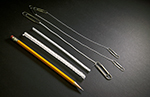
Twisting together a bundle of polyethylene fishing lines, whose total diameter is only about ten times larger than a human hair, produces a coiled polymer muscle that can lift 16 pounds. Operated in parallel, similar to how natural muscles are configured, 100 of these polymer muscles could lift about 1,600 pounds. Photograph courtesy of The University of Texas at Dallas.
A team of researchers from Lintec, Phoenix, and The University of Texas at Dallas is the 2015 gold winner in the market disruptor product category of R&D Magazine’s 100 Special Recognition Award for its HeliAct Muscles.
According to the R&D Magazine website, the HeliAct Muscles technology provides long-life, low-cost, highly controllable artificial muscle fibers that can replace expensive, bulky, heavy motors. The polymer fiber muscles can contract by over 60 percent, lift loads over 100 times heavier than can human muscle of the same length and weight, and generate 5.3kW (7.1 horsepower) of mechanical power per kilogram of muscle weight, which is five times higher than produced by a car’s gasoline engine. HeliAct Muscles have implications for use in prosthetics, humanoid robots, and exoskeletons.
For more information about this innovation, read “Researchers Create Muscles from Fishing Line, Thread.”