

A collaboration between the Istituto Italiano di Tecnologia (Italian Institute of Technology, IIT) and Alkivio produced a transfemoral prosthesis cover made from an environmentally responsible material. Alkivio, a start-up company that originated in 2022 from the joint research laboratory between the IIT Smart Materials group and Novacart, produced a new composite, based on paper, named AlkiPaper.The prototype is being presented this week at the JEC World 2026 in Paris, France.
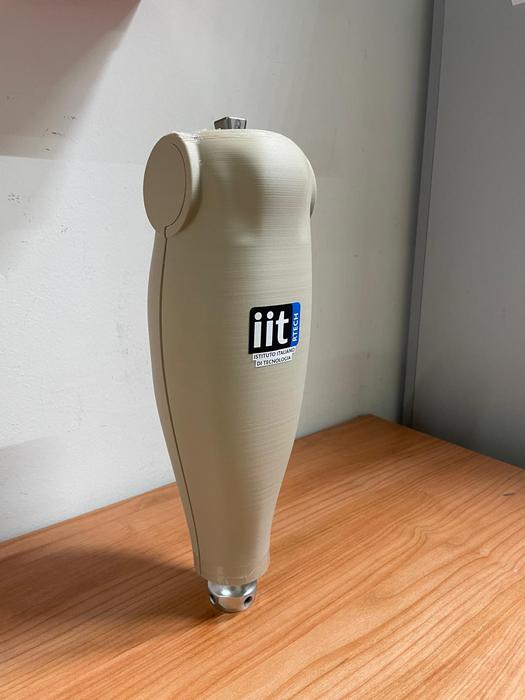
The prosthesis in the prototype is part of Omnia, a prosthetic system developed by the Rehab Technology Lab of the IIT with the Italian National Institute for Insurance against Accidents at Work, coordinated by Matteo Laffranchi, PhD. The lab is responsible for the development of prosthetic and rehabilitation medical devices.
The original system comprises a motorized knee (Unico) and a motorized ankle (Armonico). For the JEC World exhibition, researchers replaced the plastic covers of Unico and Armonico with AlkiPaper biocomposites, resulting in a unique prototype that combines advanced healthcare technology with environmental sustainability.
AlkiPaper is produced in pellet form through a patented technology licensed from Novacart and IIT. The material is designed to be biodegradable, compostable, environmentally sustainable, colorable, and compatible with the major industrial processes used for plastics such as injection molding, extrusion, thermoforming, 3D printing, and blow molding.
For some grades of AlkiPaper, biodegradability under controlled conditions has been confirmed by accredited laboratories, while industrial composting certification is ongoing. The biocomposites are mainly made from natural components, including paper from virgin cellulose or industrial residues, and are used in rigid and semi-rigid products for packaging, design, agriculture, sports, and electronics.
To make Armonico and Unico more environmentally sustainable, Alkivio formulated and optimized experimental grades of AlkiPaper biocomposites specific for 3D printing to meet the required aesthetic and mechanical performance standards. The next steps to further develop the prototypes will involve technical features validation in relevant environments and material compliance assessments for this end-use.
Editor’s note: This story was adapted from materials provided by IIT.