

OANDP-L
  • Login
No Result
View All Result
The O&P EDGE
  • PECOS
  • Magazine
    • Subscription
    • Current Issue
    • Issue Archive
    • News Archive
    • Product & Service Directory
    • Advertising Information
    • EDGE Flipbooks
  • O&P Jobs
    • Find a Job
    • Post a Job
  • EDGE Advantage
    • EA Homepage
    • EA Data
  • O&P Facilities
  • Resources
    • Product & Service Directory
    • Calendar
    • Contact
    • About Us
    • O&P Library
    • The Guide
    • Custom Publications
    • Advertising Information
    • EDGE Direct
    • Amplitude Media Group
  • PECOS
  • Magazine
    • Subscription
    • Current Issue
    • Issue Archive
    • News Archive
    • Product & Service Directory
    • Advertising Information
    • EDGE Flipbooks
  • O&P Jobs
    • Find a Job
    • Post a Job
  • EDGE Advantage
    • EA Homepage
    • EA Data
  • O&P Facilities
  • Resources
    • Product & Service Directory
    • Calendar
    • Contact
    • About Us
    • O&P Library
    • The Guide
    • Custom Publications
    • Advertising Information
    • EDGE Direct
    • Amplitude Media Group
No Result
View All Result
The O&P EDGE Magazine
No Result
View All Result
Home News

Prosthetic Hand Learns to Adapt to User

by The O&P EDGE
July 6, 2026
in News
0
SHARES
15
VIEWS
Share on FacebookShare on Twitter

Researchers in the Florida Atlantic University (FAU) College of Engineering and Computer Science addressed a challenge found in many prosthetic hands in that no person with an amputation is alike, yet most devices are built as if they are. This mismatch makes it difficult to achieve natural, intuitive control, often forcing users to constantly adapt to the device rather than the other way around.
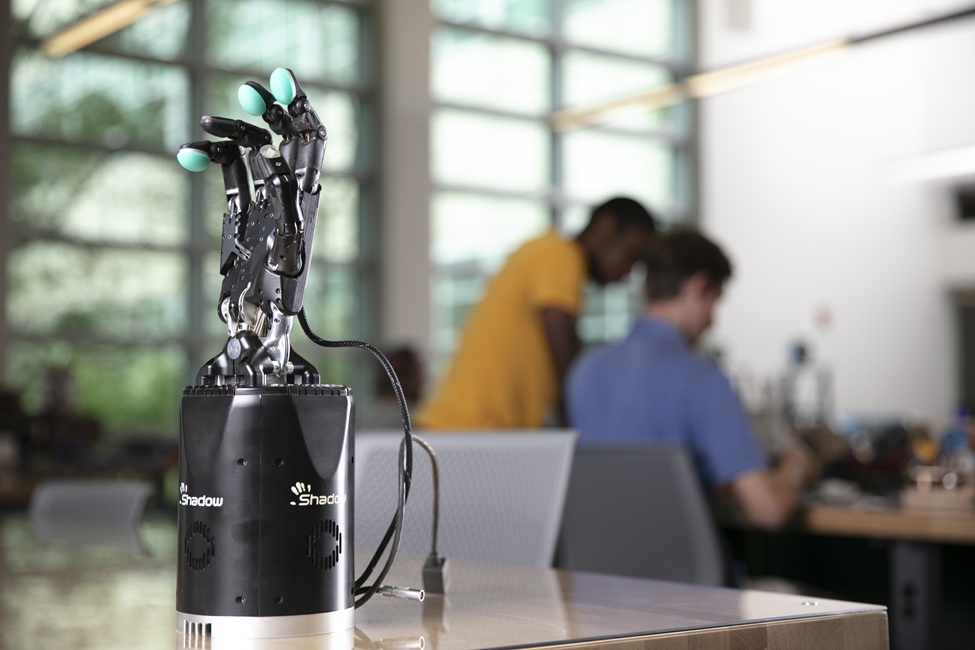
The trained AI model converts the user’s forearm muscle movements into real-time commands that control a robotic hand, allowing it to perform the intended gestures. Photograph by Alex Dolce courtesy of FAU.

To design a prosthetic system that can adapt to each individual, the researchers completed a 3D scan of participants’ residual limbs, then created a custom 3D-printed wearable sleeve embedded with soft magnetic sensors that could detect subtle muscle changes in real time. Each system was tailored with either 18 or 24 sensors depending on the user’s anatomy and paired with an individualized artificial intelligence (AI) model that learned that person’s unique movement patterns.

In testing with ten participants, including three people with upper-limb amputations, the system classified 19 hand and wrist gestures in real time, translating intent into control of a dexterous robotic hand. To assess durability, the researchers applied more than 7,500 robotic force cycles over several hours while precisely measuring sensor response. They found that the system showed a strong, stable relationship between applied force and output, accurately capturing pressure without loss of performance.

Even after thousands of cycles, signals remained clear and stable, with strong separation between signal and noise and only minor variation over time. Overall, the sensors showed no meaningful drift or degradation, maintaining accuracy, repeatability, and responsiveness essential for real-world prosthetic control.

Erik Engeberg, PhD, a professor in the College of Engineering and Computer Science, with appointments in the Department of Ocean and Mechanical Engineering and the Department of Biomedical Engineering, was the senior author of a paper about the work. He is also a member of the FAU Stiles-Nicholson Brain Institute and the FAU Center for Complex Systems within the Charles E. Schmidt College of Science.

“Prosthetic control is not one-size-fits-all. Every individual brings a distinct movement signature shaped by their anatomy, injury history, and how their remaining muscles function,” said Engeberg. “If we want these systems to truly work in everyday life, they have to be custom fit. By combining 3D-printed wearable sensors with individualized AI models, we’re moving closer to prosthetic systems that can respond naturally and in real time to a person’s intent, rather than forcing users to adapt to the limitations of the device.”

Findings also showed there is no single best sensor configuration for all users. Some participants achieved higher accuracy with fewer sensors, while others required more, with optimal setups varying based on individual anatomy and differences in injury history and remaining muscle function. In several cases, the researchers said, participants achieved more than 90 percent accuracy across multiple gestures only when the sensor layout was tailored to their residual muscles.

“Our results highlight that prosthetic performance is highly dependent on how well sensor placement and quantity are matched to the individual,” said Engeberg. “This suggests a future in which prosthetists can fine-tune sensor configurations much like a prescription, balancing both function and comfort for each user.”

The research also produced a shared dataset from all participants to provide a resource for the broader scientific community.

“This work speaks to something very practical: improving quality of life in a very direct way,” said Stella Batalama, PhD, dean of the College of Engineering and Computer Science. “When we close the gap between engineering innovation and what people actually need in their daily lives, especially for individuals who depend on prosthetic devices for independence, the impact goes far beyond the lab. It’s about restoring function, confidence, and the ability to engage with the world more naturally.”

Editor’s note: This story was adapted from materials provided by FAU.

The open-access study, “Compliant magnetic sensor arrays enable real-time force myogram pattern recognition for dexterous hand control by amputees,” was published in IEEE Transactions on Neural Systems and Rehabilitation Engineering.

To watch a video about the work, visit the university’s YouTube channel.


Related posts:

  1. Esper Bionics Names VP
  2. Just in Time for the Annual Meeting: Academy Annual Meeting Sessions Sneak Peek
  3. Opportunities for Education at Academy Annual Meeting
  4. CMS Postpones O&P Prior Authorization, Makes Policy Changes Amid Coronavirus Pandemic
Previous Post

Esper Bionics Names VP

Next Post

International Brain Study Could Improve Prosthetic Sensation, Movement

Next Post

International Brain Study Could Improve Prosthetic Sensation, Movement

 SUBSCRIBE FOR FREE


O&P JOBS

Remote

O&P Business Development Manager

Eastern

CPO/Board Eligible Prosthetist/Orthotist/ O&P Resident or O&P Technician

Eastern

Orthotic & Prosthetic Technician

Linkedin X-twitter Facebook

Get unlimited access!

Join EDGE ADVANTAGE and unlock The O&P EDGE's vast library of archived content.
SUBSCRIBE TODAY
The O&P EDGE Magazine
 

Login to your account

  • Forgot Password?

Reset Password

  • Already have an account? Login

Enter the username or e-mail you used in your profile. A password reset link will be sent to you by email.

Close
No Result
View All Result
  • PECOS
  • MAGAZINE
    • SUBSCRIBE
    • CURRENT ISSUE
    • ISSUE ARCHIVE
    • NEWS ARCHIVE
    • PRODUCTS & SERVICES DIRECTORY
    • ADVERTISING INFORMATION
  • O&P JOBS
    • FIND A JOB
    • POST A JOB
  • EDGE ADVANTAGE
    • EA Homepage
    • EA Data
  • FACILITIES
  • RESOURCES
    • PRODUCTS & SERVICES DIRECTORY
    • CALENDAR
    • CONTACT
    • ABOUT US
    • O&P LIBRARY
    • THE GUIDE
    • CUSTOM PUBLICATIONS
    • ADVERTISING INFORMATION
    • EDGE DIRECT
    • AMPLITUDE
  • OANDP-L
  • LOGIN

© 2026 The O&P EDGE

Not enough quota to unlock this post
Unlock left : 0
Are you sure want to cancel subscription?
 

Account Activation

Before you can login, you must activate your account with the code sent to your email address. If you did not receive this email, please check your junk/spam folder.

Click here to resend the activation email. If you entered an incorrect email address, you will need to re-register with the correct email address.


© 2026 The O&P EDGE

  • About
  • Advertise
  • Contact
  • EDGE Advantage
  • OANDP-L
  • Subscribe

CONTACT US

866-613-0257

info@opedge.com

201 E. 4th St.
Loveland, CO 80537

EDGE DIRECT

The most important industry news and events delivered directly to your inbox every week.

  • About
  • Advertise
  • Contact
  • EDGE Advantage
  • OANDP-L
  • Subscribe

© 2026 The O&P EDGE

Welcome Back!

Login to your account below

Forgotten Password?

Retrieve your password

Please enter your username or email address to reset your password.

Log In
The O&P EDGE Magazine
 

Login to your account

  • Forgot Password?

Reset Password

  • Already have an account? Login

Enter the username or e-mail you used in your profile. A password reset link will be sent to you by email.

Close
No Result
View All Result
  • PECOS
  • MAGAZINE
    • SUBSCRIBE
    • CURRENT ISSUE
    • ISSUE ARCHIVE
    • NEWS ARCHIVE
    • PRODUCTS & SERVICES DIRECTORY
    • ADVERTISING INFORMATION
  • O&P JOBS
    • FIND A JOB
    • POST A JOB
  • EDGE ADVANTAGE
    • EA Homepage
    • EA Data
  • FACILITIES
  • RESOURCES
    • PRODUCTS & SERVICES DIRECTORY
    • CALENDAR
    • CONTACT
    • ABOUT US
    • O&P LIBRARY
    • THE GUIDE
    • CUSTOM PUBLICATIONS
    • ADVERTISING INFORMATION
    • EDGE DIRECT
    • AMPLITUDE
  • OANDP-L
  • LOGIN

© 2026 The O&P EDGE

Not enough quota to unlock this post
Unlock left : 0
Are you sure want to cancel subscription?
 

Account Activation

Before you can login, you must activate your account with the code sent to your email address. If you did not receive this email, please check your junk/spam folder.

Click here to resend the activation email. If you entered an incorrect email address, you will need to re-register with the correct email address.