
Researchers at Chalmers University of Technology discovered that advanced brain-computer interface (BCI) technology used to restore the senses of touch and proprioception following an amputation is almost the same as the BCI being used to restore vision, despite being developed completely separately for more than 50 years.
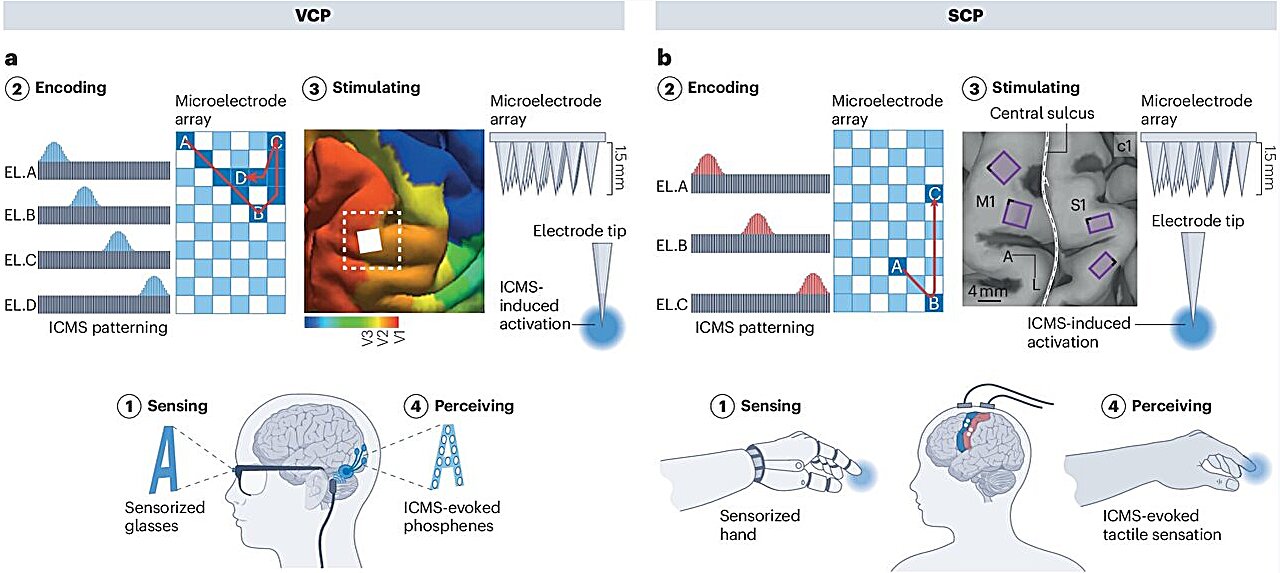
BCIs are an emerging field of technology being used for somatosensory cortical prostheses for touch and visual cortical prostheses for vision. They work by implanting a microelectrode directly into the brain to enable direct communication between the brain and external devices, such as a bionic hand. They can bypass damaged pathways in the body by directly stimulating a specific region of the brain and mimicking a natural sensation in a patient.
Natural vision and touch have common neural and computational principles in the body, whereby complex information is gathered from the outside world via the eye or the skin/hand) and converted into an electrical signal for the brain. Both fields of research have therefore been able to use similar technology to replicate these sensations artificially, with the BCIs placed in different regions of the brain..
“Normally, people work on artificial touch or artificial vision,” said Giacomo Valle, PhD, assistant professor in Bionics at the university’s Department of Electrical Engineering. “Researchers go to different conferences and deal with very different conditions and different patients, in different areas of the hospital. There has been parallel development for both senses, but we never talked about this on a global level. Until now, we hadn’t seen this as a common challenge.”
The recently published review paper, with Valle as first author, looked at how electrical stimulation of the cerebral cortex works, the types of electrodes used, how artificial visual and tactile experiences are created, the results of clinical trials to date, and what technical and clinical barriers remain.
“The idea of merging the two fields of research came from the last paper that I worked on,” Valle said. “We were going beyond restoring a simple sense of touch, moving to more complex sensations. We had to consider how to restore the sense of an edge or tactile motion. And through research, I found that the field of artificial vision was looking at the same challenge, aiming for more complex artificial vision.”
He points out that the fields of research have unique challenges and different approaches.
“Hopefully, our paper opens doors for a beneficial collaboration between the two fields and brings us closer to one technology for both artificial vision and touch that would benefit both patient groups. I have a dream for the future that there is one department in the hospital where a patient can go for ‘sense restoration’ and our unified technology would be easily accessible for all,” Valle said.
Editor’s note: This story was adapted from materials provided by Chalmers University of Technology.
The paper, “Restoring vision and touch with cortical microstimulation,” was published in Nature Reviews Bioengineering.