To make productive use of the long trek between the hotel and convention center at a recent O&P meeting, I decided to get some work done on my phone. The indoor walkway was level and without stationary obstructions. The width of the walkway allowed ample room between pedestrians. The blinking lights and upbeat ambient audio emanating from slot machines identified the transition between the walkway and the surrounding casino floor. Considering these factors, along with my decades of experience with both stable ambulation and mobile phone use, I decided that multitasking in this way represented a minimal risk to myself or others. After a few moments, I glanced up and realized that in failing to follow a gentle curve, I was now headed almost 90 degrees off my intended route. A quick adjustment remedied the situation, and I decided to complete my text exchange while stationary. I neither caus ed nor suffered any injury other than the minor embarrassment I felt when my furtive glances confirmed that others had observed my circuitous route.
According to information published by the Pew Research Center in 2025, more than 90 percent of Americans of all ages own a smartphone, except for those over 65 years old, where the percentage is 78 percent.1 Given the near ubiquity of mobile phones and surveillance cameras, it’s not surprising that many compilation videos exist online showing unfortunate results of distracted walking. One ABC News report showed videos of individuals walking into a wall, a fountain, and the path of a bear because their attention was directed at their phones. The humorous intent of many of these compilations can obscure the obvious potential for injury. Those of us who work regularly with individuals who have sustained significant injury as a result of seemingly minor accidents may be more attuned to this eventuality than the general public.
The dangers of texting while driving have been publicized for many years, and the practice is banned in 49 states.2 The risks associated with walking while using a smartphone are not as widely disseminated. According to the University of Delaware Facilities Services website, “One study conducted by the US Consumer Product Safety Commission shows that in 2011, a total of 1,152 people of all ages were treated in hospital emergency rooms in the US for injuries sustained while walking and using a cell phone or other electronic device.”3 The post noted that increased smartphone use would probably make those numbers higher now. Emergency medicine physician Dietrich Jehle, MD, has claimed that “of the 41,000 pedestrians treated in emergency rooms across the nation, as many as 15 percent of the accidents involved cellphones….”4
Multitasking
Walking while using a cellphone is commonly referred to as multitasking. In a rehabilitation research context, “practicing exercises while simultaneously performing a concurrent motor or cognitive task” is known as dual-task training.5 A 2025 scoping review con-ducted in part to develop standard operating procedures for studying the dual-task training in healthy adults, provided insight into the investigation of the impact of mobile phone use on walking.5 Dual-task training involves “performing a primary and a secondary task simultaneously. The tasks, either primary or secondary, can be motor or cognitive. The aim is to shift attention between the two tasks, and this can be modulated by controlling the difficulty of either the primary or secondary task.”5 In the following research, the primary task involved standing or walking, and the secondary task required the cognitive and motor resources associated with different types of mobile phone use.
Mobile Phone Use, Posture, and Locomotion
In 2020, Bruyneel and Duclos published a scoping review “on the influence of a dual-task situation—generated by the use of mobile phone—on users’ postural and/or locomotor tasks.”6 In their introduction they reported that “five to 30 percent of walking-related falls and accidents are directly attributable to the use of a mobile phone. People under 30—due to their frequency of use—and over 60 are more exposed to risks, particularly when writing a text message.”6 They note that “cognitive distraction, reduced visual attention to the environment, and impaired musculoskeletal biomechanics through decreasing arm and head mobility” induced by mobile phone use “may be the main factors of risk.”6
Because the number of studies with similar methodologies was limited at the time of their review, and the studies included both balance and walking tasks, the authors did not evaluate the quality of the articles. Their intent was to “identify the types of available evidence, to examine how research is conducted in this field, and to identify knowledge gaps.”6 They noted that “the extremely frequent use of a mobile phone in conjunction with daily activities makes understanding this dual task relevant for patient rehabilitation.”6 The researchers identified the target populations, types of phones, types of postural and locomotor tasks, and the environments investigated in the 46 experimental studies published between 2010 and 2019 that were included in their review.6 The focus of all the articles was “the influence of mobile phone use on the spatiotemporal parameters of postural and/or locomotor tasks” and only included quantitative measures.6 All the reviewed studies “systematically compared conditions (postural and locomotor tasks combined with the use of a mobile phone versus tasks alone).”6 The characteristics of the reviewed studies are summarized in Table 1. 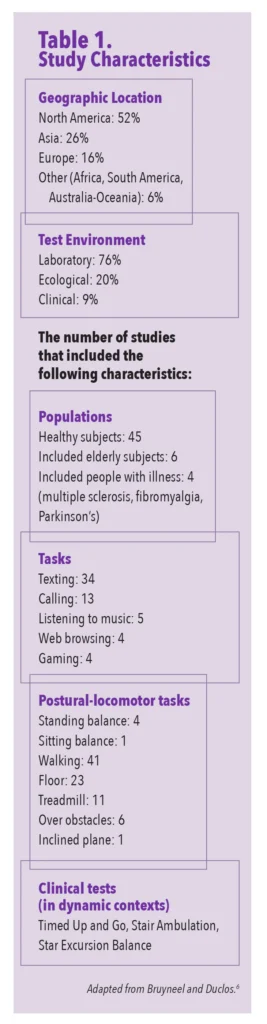
Bruyneel and Duclos reported consistent effects of mobile phone use in all 46 studies. Not surprisingly, they found that texting “induced a slowdown and increased instability” in all walking conditions except walking uphill.6 Knee and ankle angles were not affected by phone use during over ground walking. Texting and calling decreased speed during the Timed Up and Go and Stair Ambulation tests and decreased performance in the Star Excursion Balance test. They also noted that “standing balance was significantly more unstable compared to the control condition.”6 Speed and balance test performance was lower while using a mobile phone for all tasks studied except listening to music, which either did not affect or increased speed. They stated that “while movement slowdown can be considered as a precautionary compensatory strategy, the other aspects are unintentional and are direct consequences of the phone use during postural-locomotor tasks.”6 They also reported that “disturbances were greater for elderly subjects” and those with illness.6
The authors explained that “dual tasks require the simultaneous performance of two interfering tasks,” each of which “can be performed independently, measured in a distinct way, and meet its own objectives.”6 They reported that “all types of use of a mobile phone generate visual, cognitive, and fine motor activities that contribute to the modification of gait.”6 Either texting speed or spatiotemporal parameters could be used to determine the impact of the dual task, and based on the reviewed studies, Bruyneel and Duclos concluded that spatiotemporal parameters were superior “for assessing the dual-task effect.”6 They also quoted the results of a study that showed that texting while walking “involves—in order of importance—cognitive aspects, then visual aspects, and finally motor aspects” of the dual task.6
Mobile Phone Task, Age, and Gait
A systematic review and meta-analysis by Zhang et al. published in 2023 reported on 22 studies involving 592 participants that investigated “how mobile phones affect pedestrian gait” and “how mobile phone tasks and participant age affect gait differently.”7 All the studies were observational cross-sectional designs, involved using a phone while walking, reported quantitative data, and provided a comparison between walking in single and dual-task (using a mobile phone) conditions. Results of the review are summarized in Table 2.
The authors reported that “to reduce the potential risks associated with reduced walking ability (e.g., fall risk), pedestrians often exhibit a more ‘cautious’ movement pattern during mobile phone use to reduce the difficulty of movement execution, which may be the main reason for the changes in gait.”7 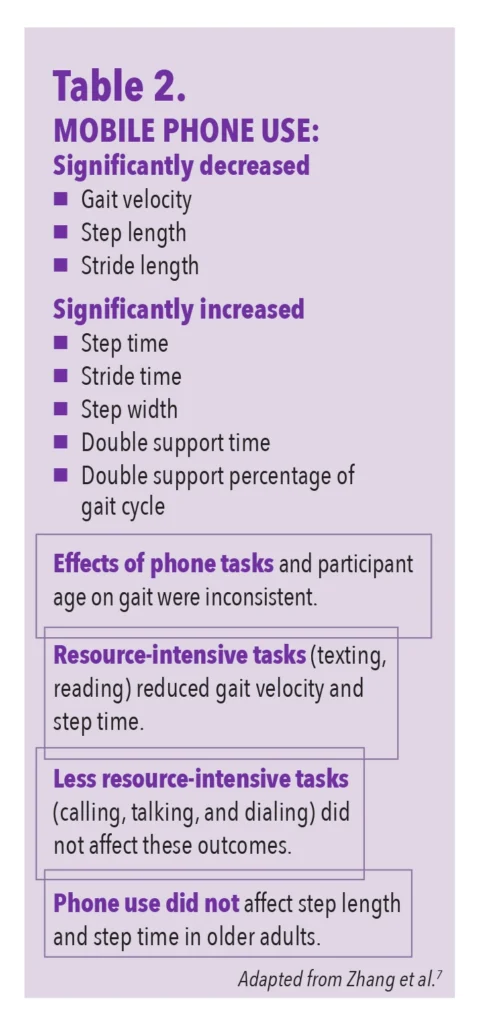
Dual-Tasking and Prosthetic Use
A systematic review published in 2023 reported on “the effect of dual-tasking on the balance and gait of people with lower-limb amputations.”8 The authors pointed out that not only does using a prosthesis increase the demands of walking, the cognitive impairment and executive dysfunction commonly present in individuals who use lower-limb prostheses compromise balance and gait.8 The authors reviewed 22 studies involving 93 participants with transtibial, transfemoral, knee-disarticulation, or bilateral lower-limb amputations. Four of the studies investigated dual-task balance and 18 investigated dual-task gait. According to the authors, “Most studies selected a discrimination and decision-making task for their secondary task,” including various verbal, motor, and arithmetic calculations.8 The authors reported that “some evidence of a differentially worse performance in PLLA [people with lower-limb amputation] was observed, characterized by increased sway velocity and reduced pace and rhythm, and increased asymmetry when balance or walking was paired with a secondary task.”8
The authors pointed out that these results “are likely to be underestimates” of the effect of dual-tasking on gait in this population. Participants in the studies were “mainly male, middle-aged adults, with predominantly transfemoral level amputations of non-vascular etiology,” and were experienced prosthesis users who did not use a walking aid.8 These limitations, along with the absence of mobile phone use as one of the tasks in any of the studies, make this review less directly relevant to the current discussion regarding mobile phones and gait. However, this review and other dual-task research on O&P populations, raise interesting clinical issues. 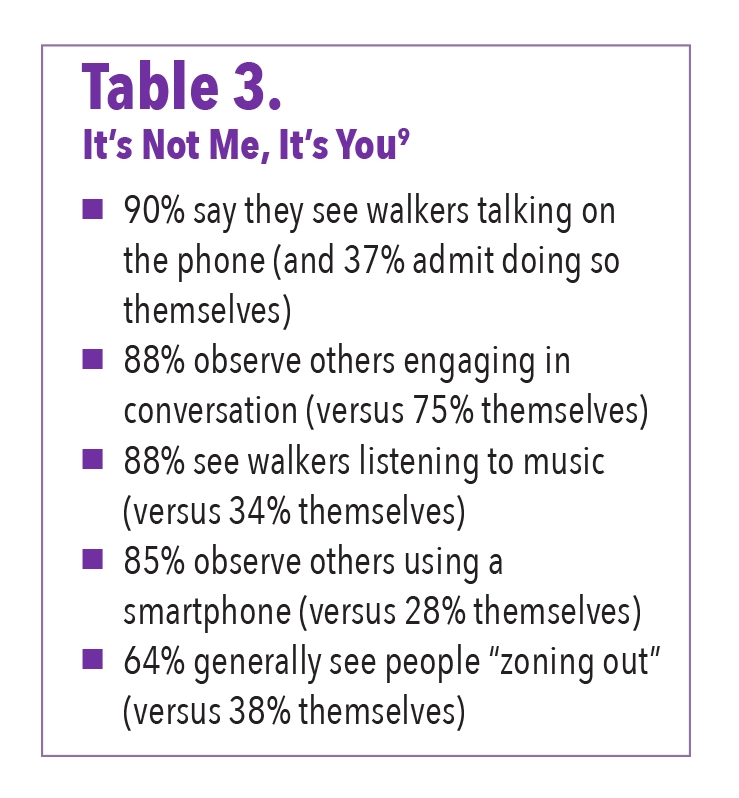
Closing Thoughts
Our patients often make both intuitive and more intentional adaptions based on their levels of impairment. They may be more aware than those of us without impairment to the obviously detrimental effects of performing other tasks while walking. Safety and mobility are usually prioritized, so adaptation often includes avoidance or modification of common dual-task activities since basic functioning with O&P devices requires more focused attention. The use of assistive devices can also make holding a mobile phone while walking impractical. For these reasons, it may be more obvious to orthosis and prosthesis users that avoiding use of a mobile phone while walking is the best choice.
The philosopher Voltaire observed that “common sense is not so common.” According to the OrthoInfo website, “while 78 percent of US adults believe that distracted walking is a ‘serious’ issue, three-quarters of Americans say it’s ‘other people’ who walk distracted. Only 29 percent of respondents admit that they, personally, have an issue.”9 More evidence of this perspective among respondents to the Distracted Walking Study by the American Academy of Orthopaedic Surgeons can be found in Table 3.
The OrthoInfo site references a study that “observed nearly one-third of pedestrians at 20 high-risk intersections in Seattle listening to music, texting, or using a cellphone. Those who texted took almost two seconds, or 18 percent, longer to cross the intersection compared with those who weren’t distracted. Those who texted were four times more likely to display at least one ‘unsafe crossing behavior,’ such as ignoring traffic signals or failing to look both ways.”9
It could be that we have accepted distracted walking as an inevitable part of the modern world in which we live. However, it would be beneficial to be more conscious of the risks associated with that behavior, especially for our patients.
John T. Brinkmann, MA, CPO/L, FAAOP(D), is an associate professor at Northwestern University Prosthetics-Orthotics Center. He has over 35 years of experience in patient care and education.
References
https://www.bts.gov/content/state-laws-distracted-driving-0
https://sites.udel.edu/fscp/tag/weekly-safety-message-14/
https://www.buffalo.edu/community-health-equity-institute/news.host.html/content/shared/university/news/ub-reporter-articles/stories/2014/February/texting_walking.detail.html
Petrigna, L., A. Amato, A. Castorina, and G. Musumeci. 2025. A standard operating procedure for dual-task training to improve physical and cognitive function in older adults: a scoping review. Brain Sciences 15(8):785.
Bruyneel, A.-V., and N. C. Duclos. 2020. Effects of the use of mobile phone on postural and locomotor tasks: A scoping review. Gait & Posture 82:233-41.
Zhang, X., Q. Li, P. Gao, and J. Zhu, et al. 2023. The effect of mobile phone task and age on gait: A systematic review and meta-analysis. Frontiers in Physiology 14:1163655.
Omana, H., E. Madou, and M. Montero‐Odasso, et al. 2023. The effect of dual‐task testing on the balance and gait of people with lower limb amputations: A systematic review. PM&R 15(1):94-128.
https://www.orthoinfo.org/staying-healthy/distracted-walking/
Opener Art: Good Studio/stock.adobe.com; Jn/stock.adobe.com; Kaspars Grinvalds/stock.adobe.com; iso100production/stock.adobe.com; CS21NNN/stock.adobe.com; Maniprasanth/stock.adobe.com