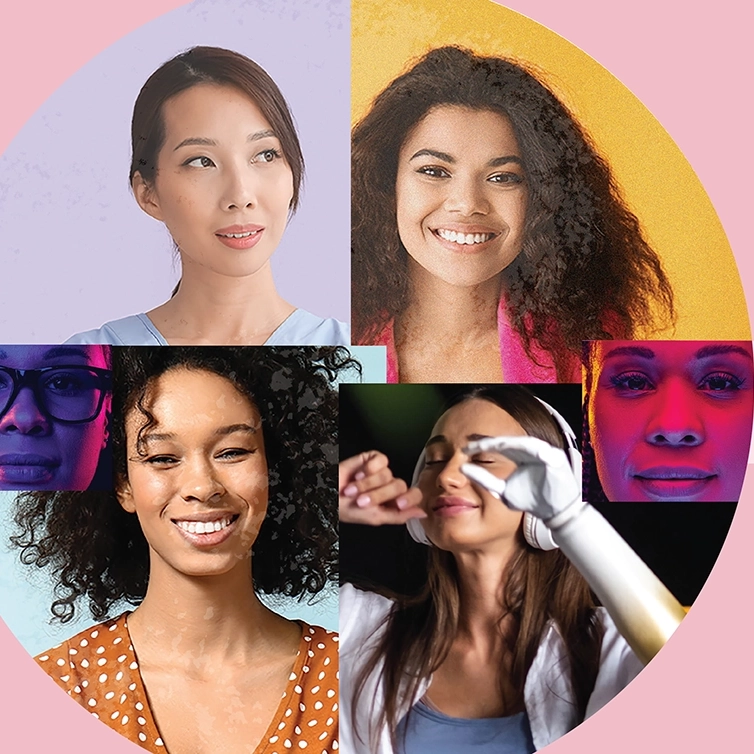
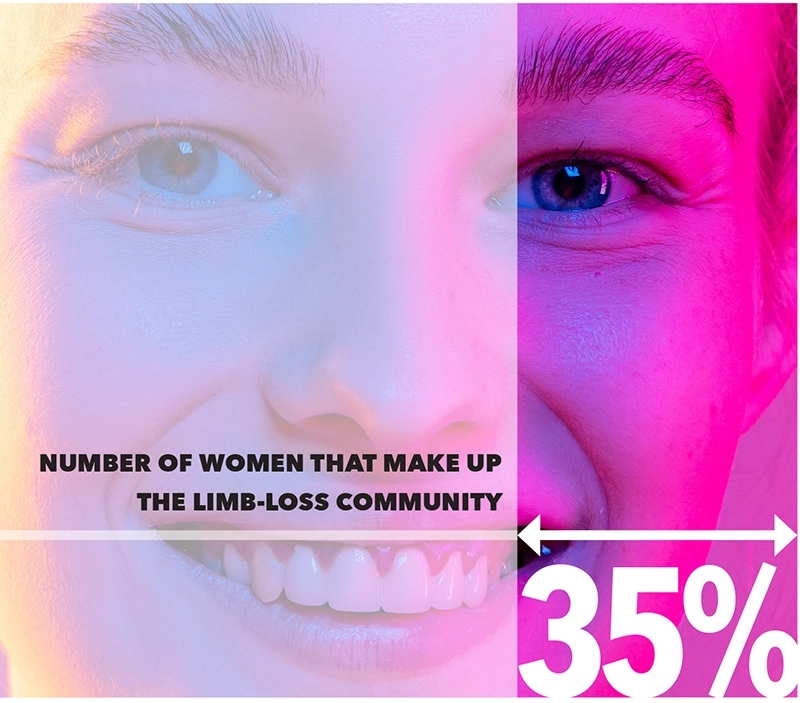
Even though women make up just 35 percent of the limb-loss community, their needs and desires deserve to be addressed.1 Unfortunately, this imbalance in the patient population means research has been done without a statistically significant number of women patients, and most prosthetic devices have been built and designed without a woman’s body in mind. In short, the experts say, the O&P community needs to do a better job in recognizing and addressing the needs of its women patients, especially as that population grows.
Changing Demographics
Historically, women have always made up a small number of patients who use prostheses. However, in recent years, their percentage has been growing slightly, mainly due to a higher percentage of women who have joined the military. From 2014 to 2019, women became the fastest-growing subpopulation of US veterans, with the number using the Department of Veterans Affairs (VA) medical services growing 29 percent.2 And as the number of women veterans grew, so too did the number of women veterans who use prostheses. According to the US General Accounting Office, in fiscal years 2015 to 2019, the proportion of these women grew from 6.8 percent to 7.9 percent and accounted for about $889.1 million of the $15.4 billion total cost of prostheses. 2
“We had this period of time where the military was dominated by men-identifying individuals who then became our veterans,” says Nicole Walker, MS, CPO, a research prosthetist/orthotist for the Minneapolis VA Health Care System. “As time has progressed, we’re seeing an increase of women-identifying individuals. That number is at its highest point, and we anticipate that number to rise. It’s estimated that they will make up 12 percent or more of the veteran population in the next few years.”
To help recognize the needs of these women, in 2017 the VA designated prostheses for women veterans a national research priority.
“The VA was seeing this uptick,” says Jason Maikos, PhD, director of the VISN 2 Gait and Motion Analysis Laboratory at the VA New York Harbor Health Care System. “When something like that happens, it’s important to ensure we are serving this population appropriately and providing the highest quality of care.”
The findings thus far? The experts say the O&P profession can do a better job of serving its women patients when it comes to both research and device design.
A Knowledge Gap
Part of the challenge of addressing the unique needs of women who wear prostheses is to determine what exactly those needs are. Until recently, that has been a bit of a research black hole because men have made up the majority of patients participating in research studies. Research shows that this underrepresentation in studies limits the accessibility of evidence-supported clinical decisions for women who wear prostheses.2,4
Experts say that this underrepresentation happens because of the availability of the patients in the region where the study is conducted and the time the researchers have to build an adequate sample group.
“For veterans with amputations, it’s a limited number of people,” says Andrew Hansen, PhD, director of Rehabilitation & Engineering Center for Optimizing Veteran Engagement & Reintegration for the Minneapolis VA. “So, oftentimes, people are running a study, and they need ten to 20 people with transtibial amputations, and it might be that 98 percent of the veterans with amputations in our region are men. The general gist of it is that there are a very limited number of women veterans with amputations in any particular area. But that doesn’t mean they’re less important because there are fewer of them.”
Experts say this trend has created a research bias which, even if not intentional, skews toward the needs of men patients.
“Something that has been talked about for a decade is the gap in knowledge of how to best treat individuals with lower-limb amputations who identify as women,” says Matty Major, PhD, associate professor in the Master of Science in Prosthetics and Orthotics program at Northwestern University. “Having engaged in prosthetic research for a long time, I recognized the limitation. I recognize the small samples we collect data from tend to be mostly men.”
Hansen says that as this trend is recognized, more will be done to help overcome it. He is conducting a study that has been funded by the VA to recruit women veterans from across the country and fly them to Minneapolis for his research.
“We’re not limited to one region,” he says. “I like this study design a lot because you don’t have to live in an urban area to participate. You can be from anywhere in the country. It’s a new way of doing this, and I hope it goes well.”
Getting the Right Fit
Since the prosthesis-wearing community skews heavily toward men, devices have traditionally been designed with a male body and biometrics in mind, the experts say. This means women patients, in general, tend to be less comfortable in their devices.
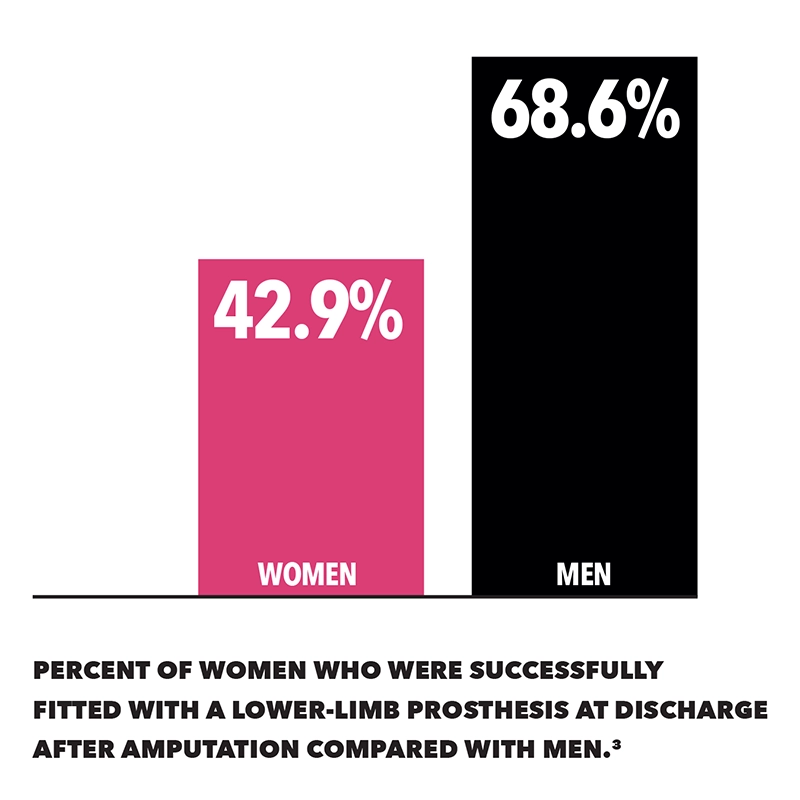
One VA study found that 42.9 percent of women were successfully fitted with a lower-limb prosthesis at discharge after amputation compared with 68.6 percent of men.3
“What works for the average-sized man may not potentially work for the average-sized woman,” says Maikos. “There have been concerted efforts to change this in the industry and through VA research, but it’s been in the last decade as opposed to the evolution of prostheses for men, which has been in development since the Civil War. It’s a slow burn, and research takes time. The VA recognizes that we need a more concerted effort and more focus on the topic and has taken the appropriate steps to provide the highest level of care for this population.”
This focus means that male-looking prosthetic hands and feet are more readily available. Also, the devices tend to be bigger and heavier than what might be best for women patients.
Studies show that this sizing issue can prompt both physical and psychological distress in women patients. Some of these issues include:
- A prosthesis that is too large or heavy can cause more movement in the socket and thus lead to skin integrity problems.5
- Women with limb loss have a significantly higher risk of developing osteoarthritis in their sound limbs when compared to the rest of the general population.5
- Women with limb loss report a greater overall pain intensity, which can interfere with daily living.6
When the fit isn’t correct, it can have a domino effect, says Roxanne Disla, OTD, OTR/L, upper-extremity occupational therapist, Bronx VA. Patients will be less likely to use their devices, thus less likely to participate in activities that require them, and that lack of participation can have a psychological impact.
“I see patients that go without wearing their prosthesis because of fit issues that affect their prosthesis use. It’s difficult for people to manage their day-to-day tasks with something that isn’t fitting them appropriately. This is why it’s so important that females—well, anyone with limb loss—receive well-fitting devices so that they can use it to accomplish what they want to accomplish with their prosthesis.”
The size and weight of the device aren’t the only facts that can impact a good fit on women patients. Cycles of their lives such as menstruation, pregnancy, and menopause can all cause volume fluctuations which, in turn, impact fit.
Angela Montgomery, CPO, owner of Prosthetic and Orthotic Group of Boulder, Colorado, says she once had a patient who had what she called her pregnancy leg. The patient, who had four children, would switch out her limb with each pregnancy because she tended to gain 40 pounds each time. Then, after giving birth, she returned to her day-to-day prosthetic limb.
Fitting women, like all patients, has to be individualized, Montgomery says. Volume fluctuations due to menstruation can be very different from patient to patient. While some women may gain very little water weight, others may have more drastic temporary changes. Montgomery says when she has a patient who reports gaining and losing a lot of water weight during menstruation, she waits until that patient is at the height of that gain before molding them.
“When they are at their largest volume is when I would take a mold of their body part,” she says. “If I mold them at a lower volume, they might not be able to wear their prostheses when they gain water weight. I think fitting them at their highest volume and then backfilling works best. Adjustable sockets that can be tightened or loosened can also work well.”
More Choice in Footwear
A common theme the researchers found was that women wanted greater choice when it came to the type of footwear they could wear with their prostheses. Walker conducted a focus group study with women veterans with lower-limb amputations that aimed to identify barriers in participation in the activities they want to be involved with.
She says wanting more footwear options isn’t just about women liking the way they look in their shoes, it’s also about feeling like themselves and comfortable with their devices. For example, they may be self-conscious in foot shells that look masculine. Also, they may not be able to wear shoes that they feel fit the activities they want to participate in: They may want to wear heels to a formal event and a different type of shoe for another activity. One woman told Walker that she couldn’t shovel her driveway because her foot wouldn’t accommodate the heel in her snow boot.
“It’s a matter of self-expression and having the ability to wear the things that make it possible to do the things you like to do,” Walker says. “Whether it’s dancing, shoveling snow, or wearing footwear to a family event or presentation, it’s about creating a scenario where your footwear options open the door to feeling more comfortable, confident, and being able to do the things you like to do.”
When patients can participate in their normal activities, it improves both their mobility and their mindset, Hansen says.
“Improving footwear options may improve veterans’ ability to participate in social roles and their satisfaction with participation,” Hansen says. “People who aren’t happy with their body image are less likely to do what they want to do, or when they do them, are less likely to be satisfied.”
Clinicians are restricted in what they can provide by the limited foot-ankle systems on the market and what insurance carriers will cover. Some feet are designed for a certain heel height and the alignment will be off if another heel height is used. Other systems allow users to change the ankle alignment, but the plantar shape of the foot doesn’t change and thus won’t allow for a wide variety of footwear.
To help address this desire for more choices, Hansen and his colleagues have been focusing their research on building a system that allows an ankle to drop into different 3D-printed feet. They’ve developed the compact foot-ankle that can drop into almost any type of shoe and hope to test it soon with women veterans.
“We’ve had ideas like this for a long time, but our recent surveys suggest this is more important than I originally thought,” he says. “Some of the women who have seen this are quite excited and ready to give it a shot.”
Asking the Right Questions
Another theme Walker found while speaking to her focus group was that many women felt that their prosthetists had preconceived ideas about what they wanted their devices to look like and how they wanted them to function.
“There’s a perception of gender-based discrepancies in their care,” she says. “They feel their needs are not well understood and met, and there’s this expectation put on women that all they care about is how they look.”
Women patients are just as diverse as men patients and though some may care more about how their prostheses look, they all want the best functioning device for them possible. Walker says that means listening to the patients and finding out how they spend their days, whether it’s balancing a toddler on their hip or sitting down for hours in an office.
“Individualizing care, I’m calling it gender-aware care, is about asking questions and adjusting your preconceived biases of how a certain person might want their prosthesis to look or function,” Walker says.
This can be a fine line to walk, Walker admits. The women patients she’s talked to say they want to be treated like any other patient, but at the same time they want their prosthetist to recognize that they may have different requirements for their devices.
“It’s like two sides of a coin,” Walker says. “They want to be seen as having similar needs as men prostheses users, but they also want their prosthetist to acknowledge they are women with amputations, and they want to be recognized for having different needs.”
Disla says that the more she talks to women patients, the more she learns about how what they want may be different than what she thinks they want.
“As clinicians, oftentimes, we assume that individuals with upper-limb loss want to be able to do all their activities of daily living with their prosthesis. However, that’s not the case for everyone. Sometimes an individual wants to use their prosthesis to put their hair up in a ponytail or hold onto a cup without dropping it, knowing that their prosthesis won’t fail them.”
Next Steps
The good news is that there has been more research focus on the needs of women who wear prostheses. Researchers have been examining the issue from the psychological, physical, and device-centric perspectives.
What’s next, Maikos says, is to start putting this research into practice.
“Once you start putting resources toward these potential issues, it then becomes a matter of those research efforts translating to clinical care,” he says. “It’s a fast-growing demographic, it’s a priority, and it takes everyone. It takes policy, it takes research, it takes implementation and clinician support.”
And once these options are available, it’s not just women who will benefit from them, the experts say. Men with slighter builds will do better with a lighter device. A foot that works well for a woman in a high-heeled shoe might also be a good fit for a man wearing cowboy boots.
“In prosthetics or orthotics, you have all types of people and identities and comorbidities, so having more customized options benefits everyone,” Major says. “There’s no reason not to address that.”
Maria St. Louis-Sanchez can be contacted at msantray@yahoo.com.
Can More Women Practitioners Make a Difference
in Women’s Care?
When Brooke Artesi, CPO/L, had a transtibial amputation 30 years ago, there wasn’t a lot of choice as far as prosthetists went.
Her parents felt that the then 15-year-old might feel more comfortable with a woman prosthetist, but there weren’t any to be found in her region.
“When we went to see a practitioner, there were no female options at all,” says Artesi, owner of Sunshine Prosthetics and Orthotics, New Jersey. “My parents had called around; there were very few options, and none were women.”
Now, as a prosthetist herself, Artesi says women patients seek her out because she’s a woman.
“The female patients do relate to me more because I’ve done and been through it all,” she says. “They come to me because I’m a female amputee, and I do understand them.”
She says her women patients want someone who is a woman, knows what it’s like to have an amputation, and can even share her own stories about what it’s like to chase after two children in a prosthesis.
Experts say that a smaller population of women using prostheses has been attributed to a lack of research on the unique needs of women and a lack of devices tailored to their biomechanics. There is also a suspicion among researchers that a smaller population of women O&P clinicians may play a role in the historic lack of focus on women’s needs.
Traditionally, O&P has been a male-dominated profession. In 2006, a survey by the American Board for Certification in Orthotics, Prosthetics and Pedorthics found that women made up 22 percent of orthotists and 12 percent of prosthetists.
Those demographics are changing, says Matty Major, PhD, associate professor of the master’s program in prosthetics and orthotics at Northwestern University. Women make up 60 percent of the current cohort of the program.
“Representation is hugely important in any healthcare profession,” Major says. “As we have stronger demographics, we’ll find out soon if it has an effect. But by the nature of it, you’d assume that women practitioners would be more attuned to the needs of women.”
An increase in the number of women practitioners will only benefit the profession because it will give patients more options, says Nicole Walker, MS, CPO, a research prosthetist/orthotist for the Minneapolis VA Health Care System.
“There is data supporting the idea that when a provider matches your identity, whether it’s a gender or racial identity, there are meaningful benefits to patients. The current research is geared toward general practice, but I think the same is relevant to orthotics and prosthetics as well,” she says.
Angela Montgomery, CPO, owner of Prosthetic and Orthotic Group of Boulder, Colorado, says that she too has been sought out by women because she’s a woman. At times, the necessary prosthetic assessment or molding can be quite intimate, she says. “Although male practitioners are perfectly capable of performing these evaluations, I have had some female patients prefer to be seen by another woman.”
“When someone is missing their limb above the knee or has a hip disarticulation, you have to capture their pelvis. This involves you putting your hands on their groin and holding their anatomy to capture its shape,” she says. “It takes a lot of trust, open dialogue, and discussion of what you’re doing and why you’re doing it.”
She says she treats all her patients with individualized care and takes the time to listen to their needs.