
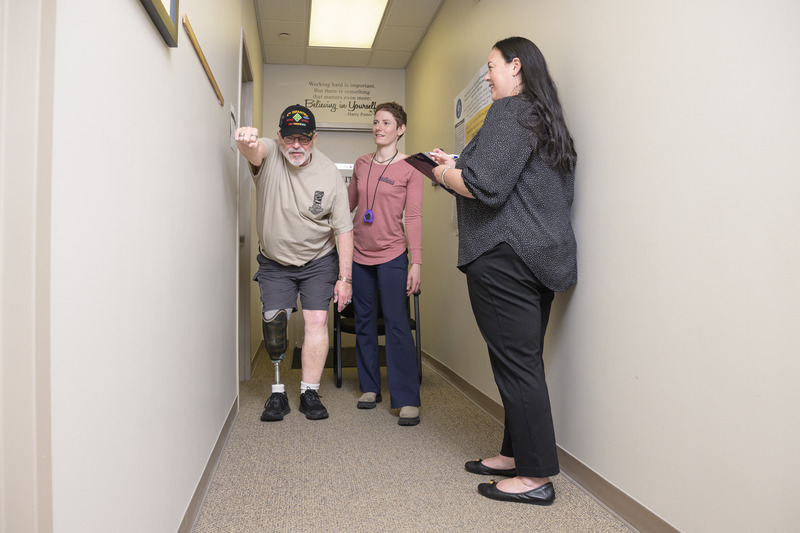
Researchers from the University of Delaware conducted a clinical trial at Independence Prosthetics-Orthotics, Delaware, to explore whether comorbidity screenings during prosthetist appointments could help improve preventive care for patients. In the study, the research team sought to determine whether the screenings were feasible, acceptable, and beneficial.
“[O&P patients are] not seeing physicians regularly, and when they are, it’s usually for an acute medical issue rather than preventive care,” said Jaclyn “Megan” Sions, PT, DPT, PhD, associate professor of physical therapy in the university’s College of Health Sciences. “When their prosthesis breaks or doesn’t fit correctly, they go to their prosthetist to solve an immediate need.”
Sions, along with postdoctoral researcher Samantha Stauffer, CPO, PhD, director of research, Independence Prosthetics-Orthotics, launched the clinical trial. The study was co-authored by Ryan Pohlig, PhD, director of the biostatistics core at the university, and focused on holistic patient management within prosthetic clinical practice.
“So many clinical trials for this population focus on technology,” Sions said. “What I love about this study is that it shows a clinical trial can be done in everyday prosthetic practice.”
The screening checked for depressive symptoms, suicidal ideation, low back pain, poor blood flow to the feet and neuropathy, or loss of protective sensation.
“Many individuals with amputations due to trauma had lost some protective sensation and weren’t getting the follow-up care or monitoring of their non-amputated limb we typically see when someone loses a limb due to diabetes or issues with blood flow,” said Stauffer, an alumna of the university’s biomechanics and movement science doctoral program.
“When patients with lower-limb loss see physicians, they, along with the physicians, ignore that they’re an amputee in the room,” said John Horne, CPO, CPed, president, Independence Prosthetics-Orthotics, who has a lower-limb amputation.
The researchers found that the screenings didn’t add significant time to patients’ appointments.
“As small businesses trying to make it, it’s important that the screenings don’t take too much extra time,” Sions said.
The study also explored whether screenings encouraged patient follow-up with medical providers.
“We learned that the vast majority of patients weren’t previously aware of possible issues identified in the comorbidity screenings, and they did seek medical attention,” Sions said.
“Mental health is a major issue for people with limb loss, but prosthetists aren’t always comfortable having these conversations,” Stauffer said. “We learned there needs to be more training so clinicians can gain confidence.”
The trial also tested whether the healthcare community would be receptive to prosthetist screenings and input.
“Historically, prosthetists aren’t always viewed as critical members of a patient’s healthcare team, and they wondered if there’d be pushback,” Sions said. “But the healthcare community was very receptive to hearing from prosthetists.”
As practitioner, Horne and Stauffer found the screenings valuable.
“It made us engage in more conversations with our patients and pay more attention to things that might affect them medically,” Horne said.
Stauffer added, “It showed my patients that I care about them as a person and enhanced my rapport with them. Physicians were responsive to concerns that I had.”
Horne said it wouldn’t take much for Independence Prosthetics-Orthotics to implement the screenings permanently, and he sees it as one way the field can evolve.
“Studies like this help elevate the prosthetics industry,” Horne said. “We have insights that no one else has, which is why we’re a specialty provider, and this helps us step outside our comfort zone and contribute to the overall healthcare of our patients.”
Sions’ research team hopes to launch a larger clinical trial to gauge feasibility on a larger scale.
“We must look at these patients holistically and address the health complexities they face,” Stauffer said. “Identifying these health problems is the first step to improving quality of life and longevity among adults with limb loss.”
Editor’s note: This story was adapted from materials provided by the University of Delaware.
The open-access study, “Prosthetist screening for comorbidity during routine care visits: A randomised controlled clinical trial evaluating benefits, acceptability and feasibility,” was published in BMJ.