
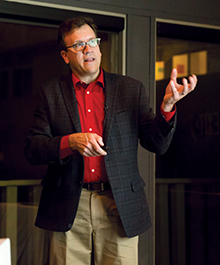
Photograph of Weber courtesy of AAD.
Restoring naturalistic hand function and sensation to people with upper-limb amputations is the goal of Hand Proprioception and Touch Interfaces (HAPTIX) program established by the Defense Advanced Research Projects Agency (DARPA) in 2014. According to Douglas Weber, PhD, program manager for DARPA, 2017-18 is the second phase of research and refinement for the HAPTIX program; 2019 is anticipated as the third phase, in which people with transradial amputations will be allowed to take home a HAPTIX-controlled system for extended trials outside the lab.
“We want to re-establish communication between the motor parts of the nervous system and the prosthetic hand through the use of implantable electronics,” said Weber. He was the keynote presenter April 23, at the 2017 Advanced Arm Dynamics (AAD) Symposium, an annual clinical education and business development meeting for the company’s team.
DARPA is working with several research teams across the country on HAPTIX, including Nerves Incorporated, Dallas, which is partnering with AAD to test motor control and sensory feedback procedures with upper-limb prosthesis users. Research involves implanting tiny electrodes in muscles between the elbow and shoulder, and in individual nerve fascicles that correspond with wrist and finger control. According to Weber, minimally invasive procedures to implant electrodes in the spinal cord are also being developed. Through these advanced neural interface systems, HAPTIX seeks to acquire and decode neural signals that could provide intuitive prosthetic control and restore sensory feedback.
During his keynote speech, Weber shared video of a HAPTIX test patient using his upper-limb prosthesis to play the guitar.
“By improving prosthesis control and feedback, we want to help people rediscover their passions in life, the things that make them happy,” Weber said.
Editor’s note: To read about a first-in-human trial of an advanced upper-limb prosthetic system to be conducted by Florida International University researchers and supported by the HAPTIX program, click here.