
The University of Alabama at Birmingham (UAB) Department of Physical Medicine & Rehabilitation transitioned its O&P residency program to a combined 18-month training model in line with new national standards. The change follows guidance from the National Commission on Orthotic and Prosthetic Education, which now requires incoming practitioners to complete integrated training in both orthotics and prosthetics. Previously, residents completed two separate 12-month residencies, one in each specialty. The combined residency shortens total training time while maintaining comprehensive clinical exposure, allowing graduates to become board-eligible more efficiently.
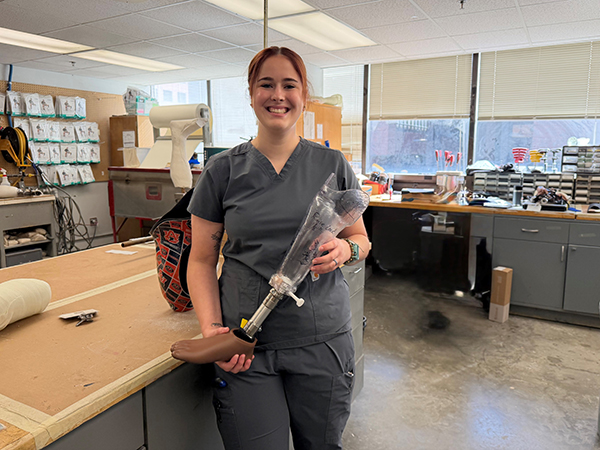
The department welcomed Meghan Hancock, MSOP, as the first resident to train under the new model.
“I chose to join UAB’s O&P residency program because I valued the collaborative, patient-centered environment,” Hancock said. “When I shadowed the clinicians, it was clear they are deeply committed to finding the best solutions for their patients. It’s an ideal place to learn how to care for patients across every stage of recovery, and I’m excited to be part of that long-term journey.”
Hancock earned a Master of Science in Prosthetics and Orthotics from Kennesaw State University in May. She also holds a Master of Science in biomechanics from Auburn University and a bachelor’s degree in exercise science. She has more than 500 hours of clinical experience across hospitals, private practices, and specialty care settings, including Children’s Healthcare of Atlanta, Shriners Children’s Hospital, and the Veterans Affairs system.
Hancock has also been recognized for her research contributions, including a project on cranial remolding orthoses in infants that received a “Game Changer” designation at the 2026 American Academy of Orthotists and Prosthetists Annual Meeting.
Editor’s note: This story was adapted from materials provided by UAB.