
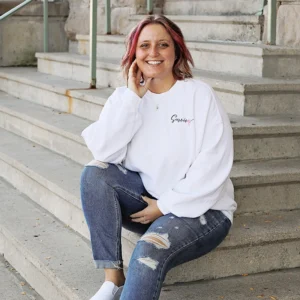
Health and wellness experts often recommend the practice of listening to our bodies, which led to a life-saving early diagnosis for Kathleen Kauffman, CFm, Personal Symmetrics, Ohio. Kauffman had developed a friendship with one of her patients, Michelle, a 33-year-old survivor of stage 3 triple-negative breast cancer. After talking to Michelle about some symptoms Kauffman was having and the history of cancer in her family, she started to perform breast self-exams.
“Growing up, you hear about breast cancer in older women, but I’ve seen some patients that are in their 30s like Michelle, and you think, ‘Oh my gosh, it can really happen to me,’” Kauffman says. “I started to do breast self-exams because I was hyper aware.”
After finding a small lump, Kauffman immediately made an appointment with her gynecologist and had a mammogram performed. While the lump turned out to be dense tissue, there was sign of calcifications in her breast. On December 5, 2024, Kauffman was diagnosed with stage 0 breast cancer at the age of 30.
Kauffman was diagnosed with ductal carcinoma in situ (DCIS), abnormal cells contained in the milk ducts that have not invaded nearby tissue. If left untreated or undetected, DCIS can spread into the surrounding breast tissue and become a more advanced cancer. According to the National Cancer Institute, 20-25 percent of new breast cancer cases in the United States each year are DCIS.
Not Ready to Give Up
Because the cancer had not spread to Kauffman’s lymph nodes, she did not have to undergo chemotherapy, radiation, or hormone therapy. Although her surgeon recommended a lumpectomy, she decided to have a double mastectomy with reconstruction—a total of four surgeries.
Kauffman says she wanted the cancer “out of my body.”
“I’m 30 years old. If I remove both breasts, I don’t have to worry about it. There are so many things I want to do with my life—I want to have a great career, live a full and happy life, possibly get married and have kids. I’m not ready to give that up yet, and that’s why I ultimately chose to undergo a double mastectomy with reconstruction.”
Kauffman received a gift on Christmas Eve 2024. “I found out they got all the cancer. I felt a sigh of relief; I’m cancer free, and I don’t need any further treatments.”
Personal Symmetrics’ Support
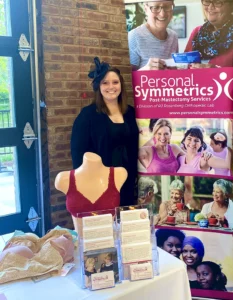
Kauffman described the support her coworkers have shown her throughout her breast cancer journey as “absolutely amazing.”
Personal Symmetrics Clinical Director Tammy Franklin, CFm, helped Kauffman get fitted for bras, compression garments, custom breast protheses from American Breast Care, and partial prostheses to give her implants a little more projection, giving Kauffman firsthand experience of the treatment their patients receive.
“We work with each client individually and give each woman the time they need to ask questions and find the garments they feel comfortable and confident in,” Kauffman says. “We want you to feel good about yourself following your appointment.”
Going through breast cancer herself, Kauffman can connect with her patients in a new way—by giving them hope.
“When a woman comes in and she has undergone a single or double mastectomy, she may have a myriad of feelings from sadness to defeat to vulnerable to self-consciousness,” she says. “I’m able to give her a sense of feeling like a woman again with a bra and prostheses. I love that I can bring a smile to my patients’ faces and give them something that they feel like they’ve been missing and help them build resilience, strength, and courage.”
How to Save a Life
Kauffman will be the first to say that early detection was key in her treatment and recovery. “Know what is right and wrong and pay attention to your body,” she says. “If something feels not quite right, get it checked.”
Peer support is also important as you go through your cancer journey, she adds.
“Your friends and family are great and will absolutely support you, but to have that connection with someone who went through the same experience as you, who knows what you’re going through, and what you’re feeling is huge,” she said. “It was helpful to know that all the feelings surrounding my experience were valid.”
Ultimately, if it weren’t for her experience treating patients after mastectomy, Kauffman’s story might have been different.
“My job saved my life,” she says.
Madeline Zukowski is the senior writer/publications coordinator of RSPR Marketing & Communications. She earned a Bachelor of Arts degree in journalism from Creighton University and a Master of Arts degree in corporate communication from Marquette University. She can be contacted at madeline@rspr.com.
Photographs by Wendy Magee and Personal Symmetrics.